
You've never had any prospecting training, and someone told you AI would do everything for you. So you open ChatGPT, paste a LinkedIn profile, and get a message that's... a little too polite, a little too long, a little too "AI." No surprise there. Using ChatGPT for prospecting, or Claude or Mistral, means handing your work to a general-purpose AI that doesn't know how to prospect. It writes well, as long as you know exactly what to ask for. In this article, we compare all three on a real use case, pit them against a specialized agent, and help you choose. 🤖
ChatGPT for prospecting: a do-it-all AI, not a prospecting expert
ChatGPT, Claude, and Mistral are general-purpose assistants. The same tool helps you write a poem, fix code, summarize a contract, or draft a LinkedIn message. That's their strength, and also their limit. They specialize in nothing. They don't know what makes a prospect reply, they don't know your target, and they aren't connected to LinkedIn. ChatGPT prospecting means using the AI as a fast ghostwriter, steered by someone who knows how to prospect.
In practice, these AIs help with four tasks. Each time, the quality of the output depends on what you already know.
Defining your target
An AI helps you go from "I sell to SMBs" to a precise description of your target. You still have to feed it the right information: your best customers, what they have in common, the decision-maker's job title, and the problem they're trying to solve. If you don't know how to define your ideal customer profile, the AI won't know any better. It'll give you a generic, plausible target, and not always the right one.
Researching an account before reaching out
Ask the AI to sum up what a prospect's company does and the challenges it likely faces. Versions with web search pull the information from the internet. Careful, though. The AI sometimes gets things wrong or makes up a detail. Fact-check anything you mention in a message before you send it, or you lose credibility from line one.
Writing invitations, messages, and follow-ups
This is the most common use of ChatGPT for prospecting. It's also where the gap opens up. A vague instruction gets you a generic message, often long and salesy, and that tanks your LinkedIn reply rate. To get a good draft, you need to know what a good prospecting message looks like, and tell the AI. Our 5 LinkedIn invitation message examples and our guide to writing a LinkedIn prospecting message give you the basics.
Practicing for objections
"It's too expensive." "We already have a provider." "Get back to me in six months." Ask the AI to play your prospect and critique your answers. It's risk-free practice, and arguably where a general-purpose AI helps most. Our article on objection handling gives you the answers that work best.

Your prospecting agent at half price, for life
€100€50/month, annual plan
Nov 27 12am to Nov 28 noon CET
Discover Waalaxy AI →14-day free trial
The real cost of using an LLM for prospecting: the prompt
An LLM doesn't know the rules of LinkedIn prospecting. You have to teach it, in every conversation or through permanent instructions. Our ChatGPT prompts for marketing and sales give you a starting point, but you'll need to adapt them. For a message with a real shot at getting a reply, your prompt has to spell out:
the target : who the prospect is, their job title, their company, and why them in particular.
the context : a recent signal (hiring, fundraising, a post) that gives you a reason to write now.
your offer : what you sell, in one sentence, and the problem you solve.
the length : under 300 characters, or the AI writes a sales email.
what to avoid : no links, no "we" over and over, no generic compliments.
the goal : one simple question, not a meeting request in the first message.
what comes next : when to follow up, what to say in the follow-up, and when to stop.
All of this assumes you already know how to prospect. Every rule on this list comes from analyzing millions of messages. Our LinkedIn prospecting statistics show, for example, that messages under 300 characters get about a 20% reply rate in French, versus 10% above 1,000 characters. A beginner doesn't know these rules, and the AI won't whisper them in their ear. Then you need time, and that's the hidden cost of ChatGPT prospecting: writing the prompt, testing it, fixing what drifts, and reworking it for every new target. With an LLM, you become the prompter, and you're the one bringing the expertise.
The test: 3 general-purpose AIs vs. a specialized agent
To check all this, we ran a hands-on test. We put ChatGPT prospecting to the test, along with Claude and Mistral: ChatGPT on an entry-level paid plan, Claude on an enterprise plan with its most advanced model, and Mistral (Vibe) on the free version. Each one had to write a LinkedIn invitation (with no note, since a connection request without a note gets accepted more often), a first message after acceptance, and a follow-up. The prospect: the HR director of a 120-employee SMB that hires a lot of sales reps. We gave Waalaxy AI the same exercise.
The setup
The test ran in two rounds, to measure how much ChatGPT prospecting depends on the person writing the prompt:
A simple prompt, the kind a beginner would write: the target, the offer, and the goal, in a few lines.
An expert prompt, with all the rules listed above.
Waalaxy AI got no writing rules at all, only its target, a description of the offer, and a goal. We then scored each message on five criteria from our study:
Criterion | Why it matters |
|---|---|
Under 300 characters | About 20% reply rate in French, vs. 10% above 1,000 characters |
No link in the first message | 18.88% reply rate without a link, vs. 11.69% with one |
No "we" over and over | The more "we," the lower the reply rate |
One simple question | 19% reply rate without a pushy call to action, vs. 12.34% with one |
A hook about the prospect | Personalizing to the profile is what separates a message that gets read from one that gets ignored |
ChatGPT, Claude, and Mistral with a simple prompt
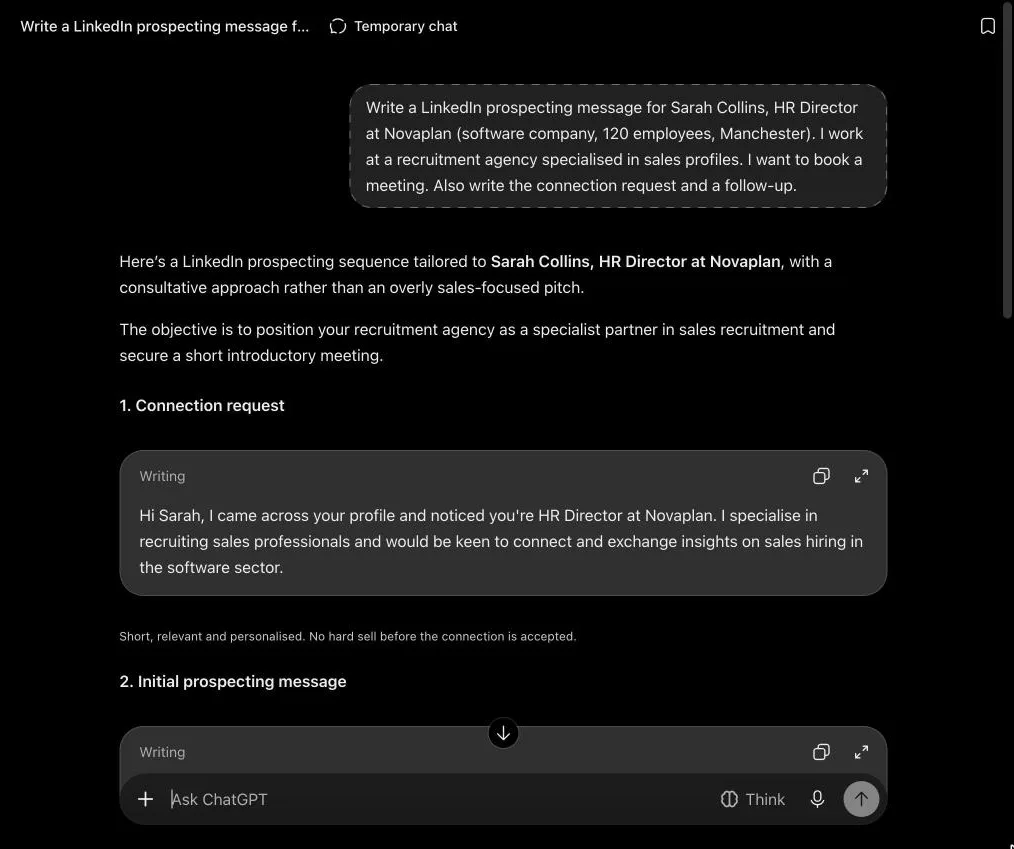
For this first round of ChatGPT prospecting and its two rivals, the simple prompt fit in three sentences: the prospect, the offer (a recruiting agency specializing in sales profiles), and the goal (landing a meeting). We ran the test in French, so the messages quoted below are translated. The result? All three AIs wrote the kind of messages you'd expect from a rushed salesperson. They were long and all about the agency, not the prospect.
First message | ChatGPT | Claude | Mistral |
|---|---|---|---|
Length | 522 characters | 762 characters | 893 characters |
Asks for a meeting in the first message | Yes (15 minutes) | Yes (20 minutes) | Yes (20 minutes) |
Mostly talks about the agency | Yes | Yes, with "we" three times | Yes, with a bulleted list |
Score out of 5 | 2/5 | 2/5 | 2/5 |
None of the messages comes in under 300 characters, and every one of them asks for a meeting from someone who has barely accepted the invitation. ChatGPT's first message, for example, opens with "I help software companies recruit their sales talent" and closes with "Would you be available for a 15-minute chat next week?" It's fine on paper, but it's exactly the kind of message prospects ignore.
ChatGPT, Claude, and Mistral with an expert prompt
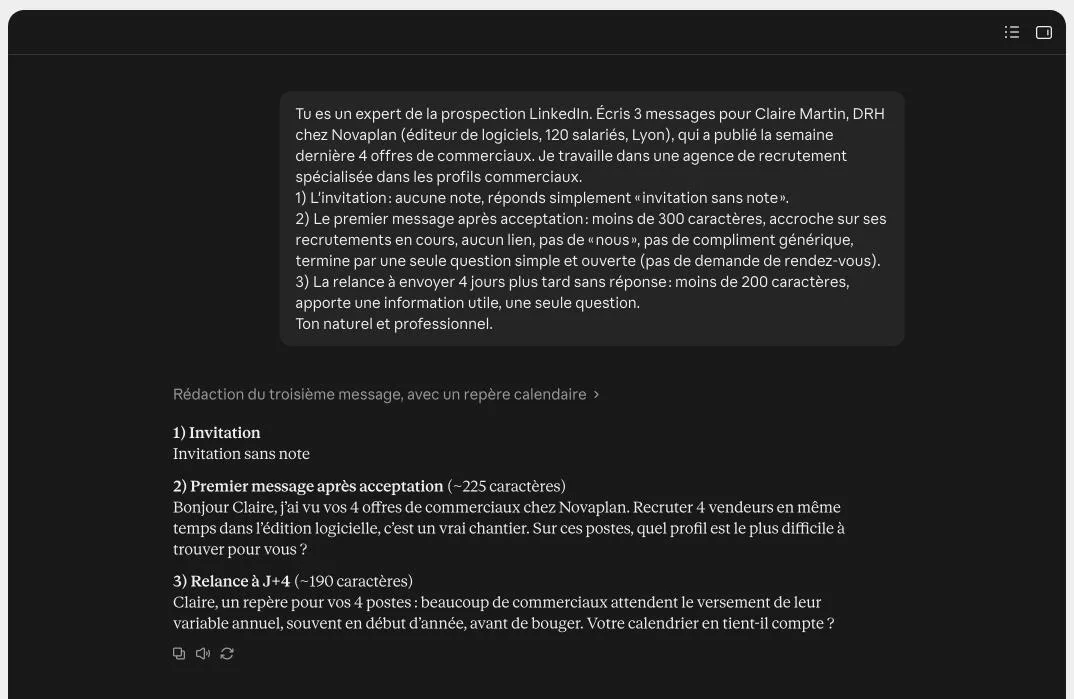
Round two: the same request, but with every rule an experienced prospector follows (under 300 characters, a hook about her current hiring, no link, no "we," one open question, a follow-up that adds useful information). The difference is dramatic:
First message | ChatGPT | Claude | Mistral |
|---|---|---|---|
Length | 244 characters | 223 characters | 249 characters |
Hook about the prospect's hiring | Yes | Yes | Yes |
One question, no meeting request | Yes | Yes | Yes |
Score out of 5 | 5/5 | 5/5 | 5/5 |
Claude, for example, wrote: "Hi Claire, I saw your 4 sales openings at Novaplan. Hiring 4 reps at once in software publishing is a big project. For these roles, which profile is hardest for you to find?" All three AIs jump from 2/5 to 5/5. The one catch: they're bad at counting their own characters. Mistral, for instance, claimed 167 characters for a follow-up that ran to 191, so always double-check.
The lesson is clear: same AIs, only the prompter changed. With a beginner's prompt, they write messages people ignore. With an expert's prompt, they write good messages, but you have to know the rules to write that prompt.
Waalaxy AI, no prompt
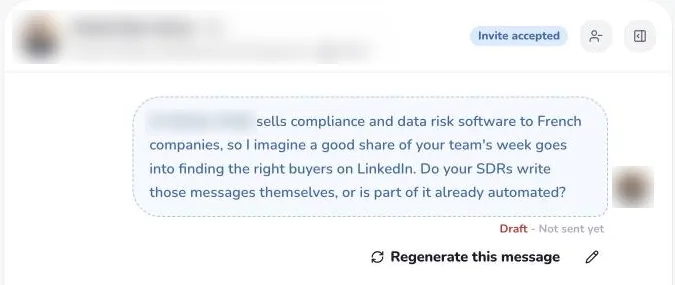
An agent finds its own prospects, so there was no way to hand it our fictional HR director. Instead, we took the sequence waiting for approval on our test agent, which targets sales directors at software companies. It got no writing rules, only its target, a description of the offer, and a goal: book a call. The prospect is the head of sales at a compliance software company. Here's the first message the agent wrote:
"Hi [First name], [Company] sells compliance and data risk software to French companies, so I imagine a good share of your team's week goes into finding the right buyers on LinkedIn. Do your SDRs write those messages themselves, or is part of it already automated?"
First message | Waalaxy AI |
|---|---|
Length | 262 characters |
Hook about the prospect's business | Yes |
No link, no "we" over and over | Yes |
One question, no meeting request | Yes |
Score out of 5 | 5/5 |
The sequence continues with a follow-up that introduces the offer and suggests a call, then a final two-line message that simply asks who handles prospecting at the company. Without a single line of prompt, the agent applies, right from the start, the rules we had to spell out word for word to make ChatGPT prospecting work, and the same for Claude and Mistral.
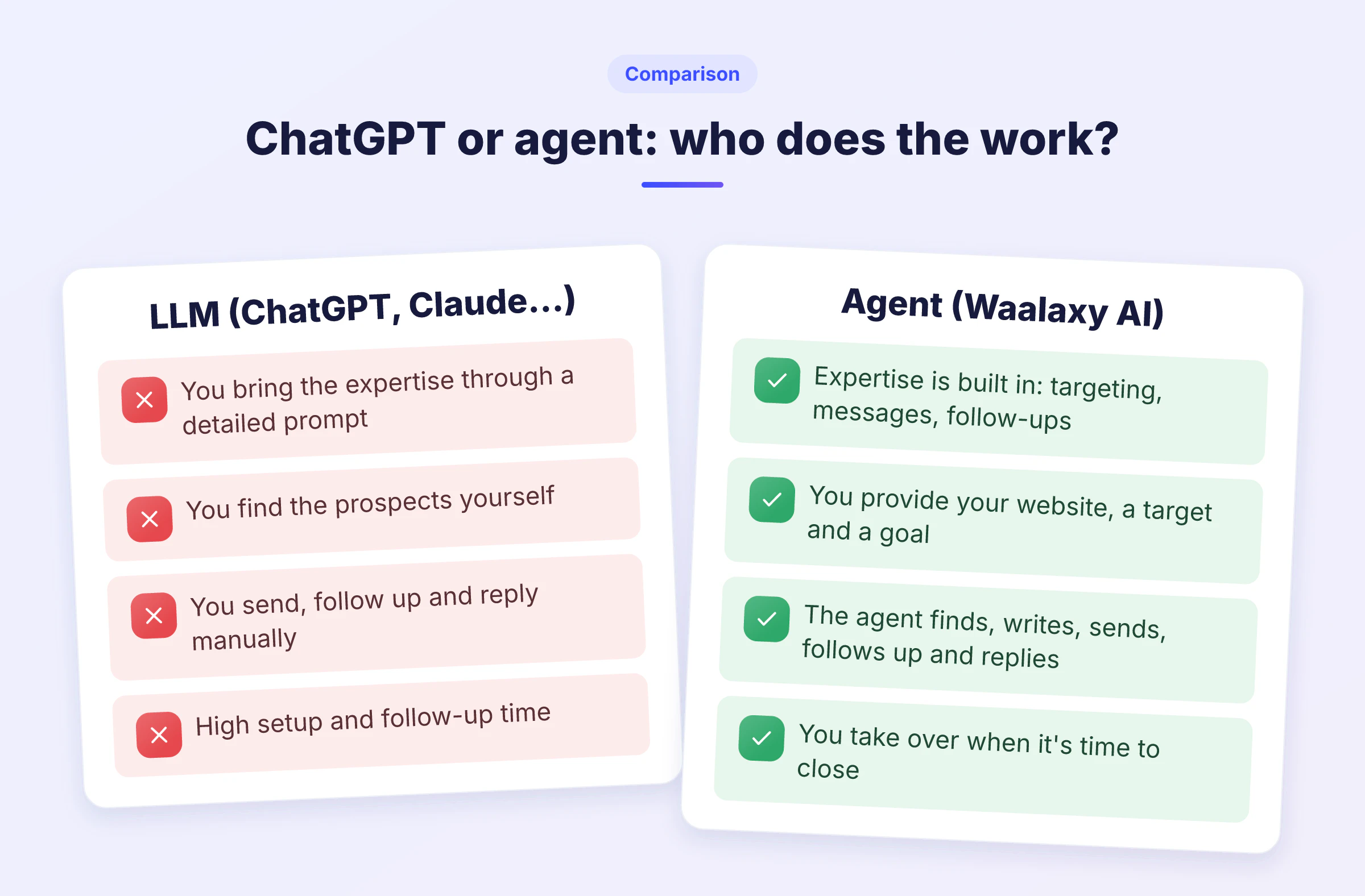
Even with the best prompt, an LLM stops at the draft. You still have to find the prospect, send the message, follow up at the right time, and reply. A specialized agent does all of it, and it already knows what to write.
ChatGPT, Claude, Mistral, or Waalaxy AI: the comparison
The real question isn't "which LLM writes best?" It's "who does the prospecting work, and how much time do you spend on it?" Here's how they stack up on what matters for prospecting:
ChatGPT, Claude, Mistral | Waalaxy AI | |
|---|---|---|
Knows the rules of LinkedIn prospecting | No, you have to provide them | Yes, built on Waalaxy's experience |
What you need to provide | A detailed prompt to write, test, and maintain | Your website URL, a target, and a goal |
Expertise required | Knowing how to prospect and how to prompt | None. The agent is built for people who've never prospected |
Finds and filters prospects | No | Yes, even without Sales Navigator |
Sends, follows up, and replies on LinkedIn | No | Yes, with your approval if you want |
Remembers your offer and your edits | Only if you set it up | Yes, with Memory |
Price | Free, or an individual plan (for example Claude Pro at $20 or Mistral Pro at $14.99 per month) | €100 per LinkedIn account per month, 14-day trial |
If you still want an LLM on the side, to prep for a meeting or practice handling objections, here's how they differ, based on each company's official pages in November 2026. Good to know: Mistral's assistant, long called Le Chat, now goes by Vibe.
ChatGPT (OpenAI) | Claude (Anthropic) | Mistral (Vibe) | |
|---|---|---|---|
Individual plan | Go, Plus, or Pro, billed monthly | Pro: $17 per month billed annually, $20 billed monthly | Pro: $14.99 per month, excluding tax |
Team plan | Business, from 2 users | Team: $20 per seat per month billed annually, $25 billed monthly | Team: $24.99 per user per month, excluding tax |
Trains on your conversations (individual plans) | Yes by default, with an opt-out | Only if you opt in | Yes by default, with an opt-out |
Data hosting | Not specified on the pricing page | Not specified on the pricing page | European Economic Area by default |
Which option fits your profile
Between ChatGPT prospecting and an agent, the right choice depends less on the tool than on what you already know how to do and how much time you want to put in:
You've never had any prospecting training : an LLM won't fill that gap, since you need to know what to ask it. An agent like Waalaxy AI brings the method with it. Most people who prospect are in that boat: 75% of Waalaxy customers had never prospected before.
You're short on time : writing and maintaining prompts, copying profiles, and sending and following up by hand eats up hours every week. An agent handles that work while you take care of your customers.
You're an outbound expert who likes building your own tools : a well-prompted LLM helps you write faster, as long as you're willing to put in the time and send everything yourself.
You need occasional backup (prepping for a meeting, practicing, rewording a proposal): ChatGPT for prospecting, Claude, and Mistral all do the job well as a sidekick.
The limits of general-purpose AI for prospecting
The test proves it: with good guidance, an LLM writes solid drafts. But ChatGPT prospecting runs into six limits, and they apply to Claude and Mistral too:
They don't know how to prospect. They're trained on text from across the web, which means on average prospecting. The rules that get a prospect to reply? You have to know them and write them down yourself.
They don't find your prospects. None of them has access to LinkedIn or Sales Navigator . You search, sort, and copy profiles yourself, then you have to qualify each prospect by hand. And a hand-built list contains 30% false positives on average.
They don't send anything. You copy, paste, and send every message by hand.
They don't follow up. Nothing reminds you to send the LinkedIn follow-up four days later, or to stop it because the prospect replied.
They forget the context. Without setup, you have to re-explain your offer, your target, and your rules in every new conversation.
They don't scale. Copy-pasting works for five prospects a day. At fifty, you spend your whole day shuttling between the AI and LinkedIn.
On top of these practical limits, there's a compliance issue people often forget when they paste profiles into a chat.
This isn't a flaw in LLMs. They're not built for this job. Our guide to AI prospecting explains where they fit in a method. That's the whole difference between an assistant and an AI agent, and the reason an AI sales rep is more than a chatbot.
Waalaxy AI: the agent that already knows how to prospect
With an LLM, you bring the expertise. With Waalaxy AI, the expertise is built into the agent. It knows who to target, what to say to a prospect, when to follow up, and how to run the conversation, because it's built on Waalaxy's years of LinkedIn prospecting experience: more than 100 million messages sent through Waalaxy in 7 years. An LLM learned from average prospecting.
The result: setup is minimal. You don't write a prompt:
You enter your website URL.
The agent reads it and suggests 2 to 4 targets, with one recommended.
You pick your goal: book a meeting, drive visits to your website, or get people to try your product.
You approve a few sample messages.
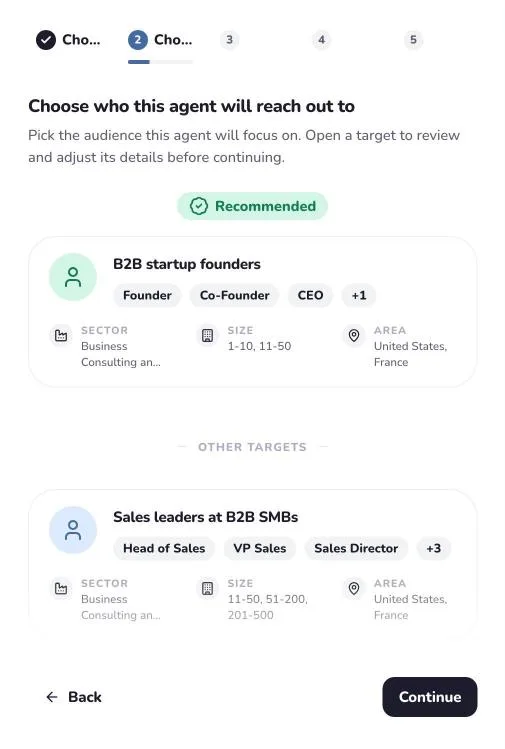
From there, the agent finds prospects (even without Sales Navigator), filters out the ones who don't match your target, and writes a sequence for each one, based on their profile and in their language. As soon as a prospect replies, the sequence stops and the agent runs the conversation until it's your turn to close.
You don't need to spend time on it for it to work, but you stay in control:
Memory : a few short instructions about your company and your offer, which the agent applies to every message. It also learns from your edits.
Autonomy level : in assisted mode, you approve each message before it goes out (edit, regenerate, reject). Once you trust it, you give it more freedom, and it checks in with you when it needs you.
To learn how to set this autonomy, read our guide on theautonomous AI prospecting agent. And to see what AI changes in practice, our AI prospecting statistics and our roundup of AI prospecting tools break it all down.
Waalaxy AI costs €100 per LinkedIn account per month (20% off with annual billing), with a 14-day free trial, with or without a credit card.
ChatGPT prospecting: the key takeaways
ChatGPT, Claude, and Mistral are do-it-all AIs, not prospecting specialists. To get a good message out of them, you need a precise prompt, written by someone who already knows the rules of LinkedIn prospecting, plus time to test and maintain it. Even then, they stop at the draft. Finding prospects, sending, following up, and replying are still on you. Use ChatGPT for prospecting support, to prep for a meeting or practice. To prospect for real, pick an agent that already knows how. With Waalaxy AI, you share your website, the agent brings the method, and you stay in control of what goes out.
FAQ: ChatGPT prospecting
For writing, yes. The free version is enough to draft invitations, messages, and follow-ups. But free ChatGPT prospecting has a hidden cost: time, like any AI prospecting done by hand. You have to write a precise prompt, find prospects, copy their profiles, then send and follow up manually. That's the time an agent like Waalaxy AI saves you.
With an LLM, yes. To succeed at ChatGPT prospecting, or with Claude or Mistral, you need to know how to prompt. These tools only apply the rules you give them: length, tone, hook, no link, follow-up timing. If you don't know those rules, the AI won't make them up. With a specialized agent like Waalaxy AI, the rules are already built in. You share your website and your target, and the agent knows what to write.
Both write well, whether you use Claude or ChatGPT for prospecting. The difference comes mostly from the quality of your instructions, not the tool. If you don't want to spend time writing and tweaking prompts, a specialized agent is a better fit.
Not automatically. Mistral is a French company and hosts data in the European Economic Area by default. But on its individual plans, your conversations help train the models unless you turn that off, same as ChatGPT. For all three tools, check:
whether conversations are used to train the models, and whether you're able to turn that off.
where the data is hosted.
whether the business plan offers a data processing agreement.
Not ChatGPT, Claude, or Mistral. They write, but they don't send anything on LinkedIn. To automate sending messages you write yourself, there's the Waalaxy sequence. For an AI that finds prospects, writes, sends, follows up, and replies, with your approval if you want, that's what Waalaxy AI is for.