
87% of sales organizations already use AI, according to Salesforce. Yet reps only save 4.8 hours a week on average, and most of them don't reinvest that time in selling. That's the paradox this year's AI prospecting statistics reveal. 👽
We combed through studies from Salesforce, Gartner, LinkedIn, Bain and the Bridge Group, plus benchmarks from outbound platforms, to keep 25 reliable numbers. Each sourced statistic tells you who published it and on what sample. You'll find AI adoption, time saved, the effect on results, reply rates for cold email and LinkedIn, and the limits that tool vendors mention less often.
The 10 AI prospecting statistics to remember
No time to read it all? Here's the gist in one table. The details and context for each of these AI prospecting statistics follow in the sections below. 📊
# | Number | What it measures | Source |
|---|---|---|---|
1 | 87% | Sales organizations that use some form of AI | Salesforce, State of Sales 2026 |
2 | 54% | Sellers who have already used AI agents | Salesforce, State of Sales 2026 |
3 | 26% | French small businesses and SMEs that use at least one AI tool (13% in 2024) | France Num 2025 barometer |
4 | 4.8 h | Time saved per week thanks to AI | Gartner, 2026 |
5 | 3.7x | Likelihood of hitting quota for a seller who works well with AI | Gartner, 2024 |
6 | +28% | Average increase in reply rate among sellers who improved it with AI | LinkedIn, The ROI of AI, 2025 |
7 | 3.43% | Average cold email reply rate | Instantly, 2026 benchmark |
8 | 26% | Average LinkedIn invitation acceptance rate | Belkins x Expandi, 2025 |
9 | 60% | SDRs who hit their quota, the lowest level ever measured | Bridge Group, 2025 |
10 | 69% | B2B buyers who turn to a sales rep to verify what AI told them | Gartner, 2026 |
Reading through these AI prospecting statistics, one trend stands out fast: AI is everywhere, but it only pays off for teams that use it well. The rest of the article shows where the difference is made.
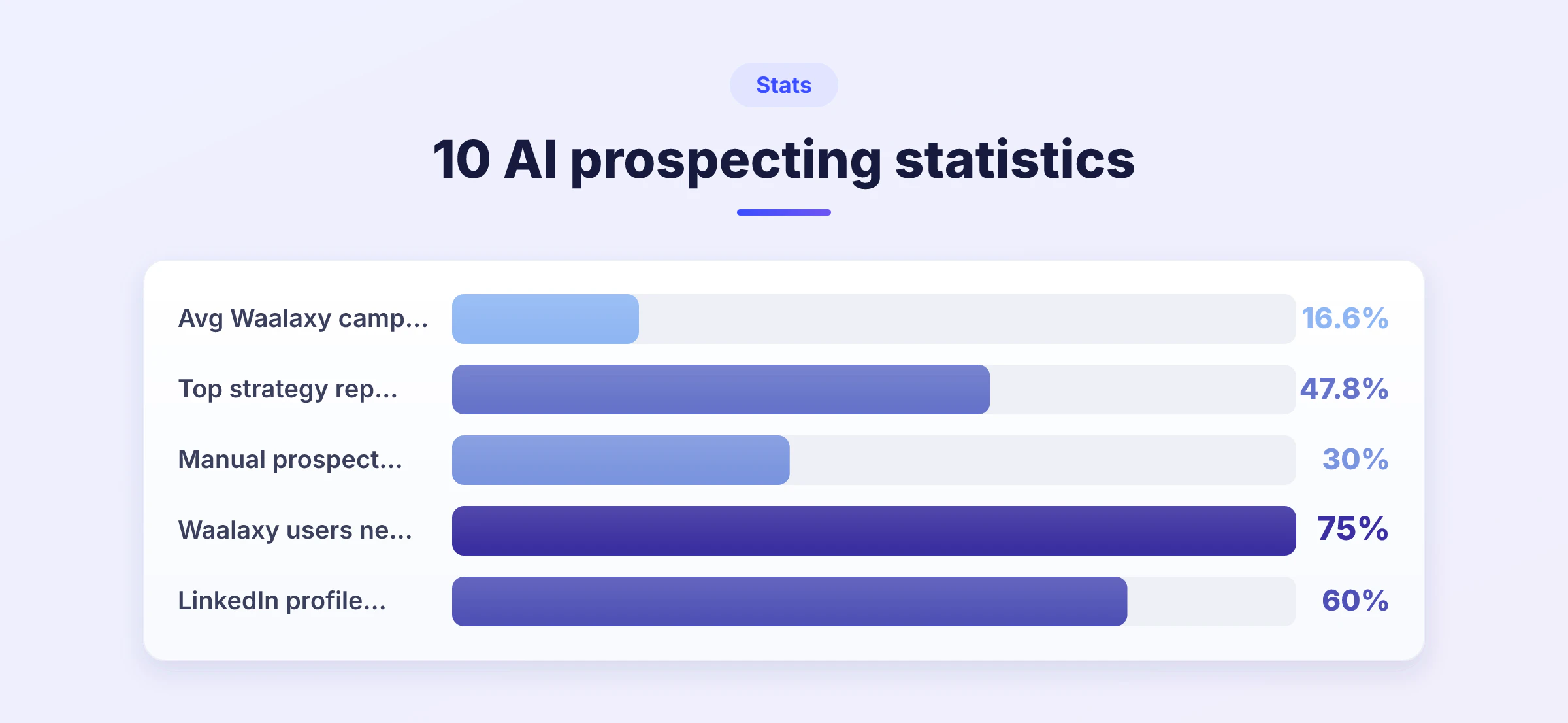
Adoption: how many sales reps use AI?
First lesson from the AI prospecting statistics: AI has left the testing phase. In two years, it has become an everyday tool for most sales teams, including small French companies. 🚀
87% of sales organizations use some form of AI. The Salesforce survey polled 4,050 sales professionals in 22 countries, including France, in fall 2025. In 2024, 81% were experimenting with it or had deployed it.
54% of sellers have already used AI agents, and nearly 9 out of 10 plan to by 2027 (Salesforce, 2026).
55% use AI to prospect, and 38% plan to adopt it for that purpose (Salesforce, 2026).
56% of sales professionals use AI every day, and 88% every week. This comes from a LinkedIn study conducted by Ipsos among 1,250 sales reps in 2025.
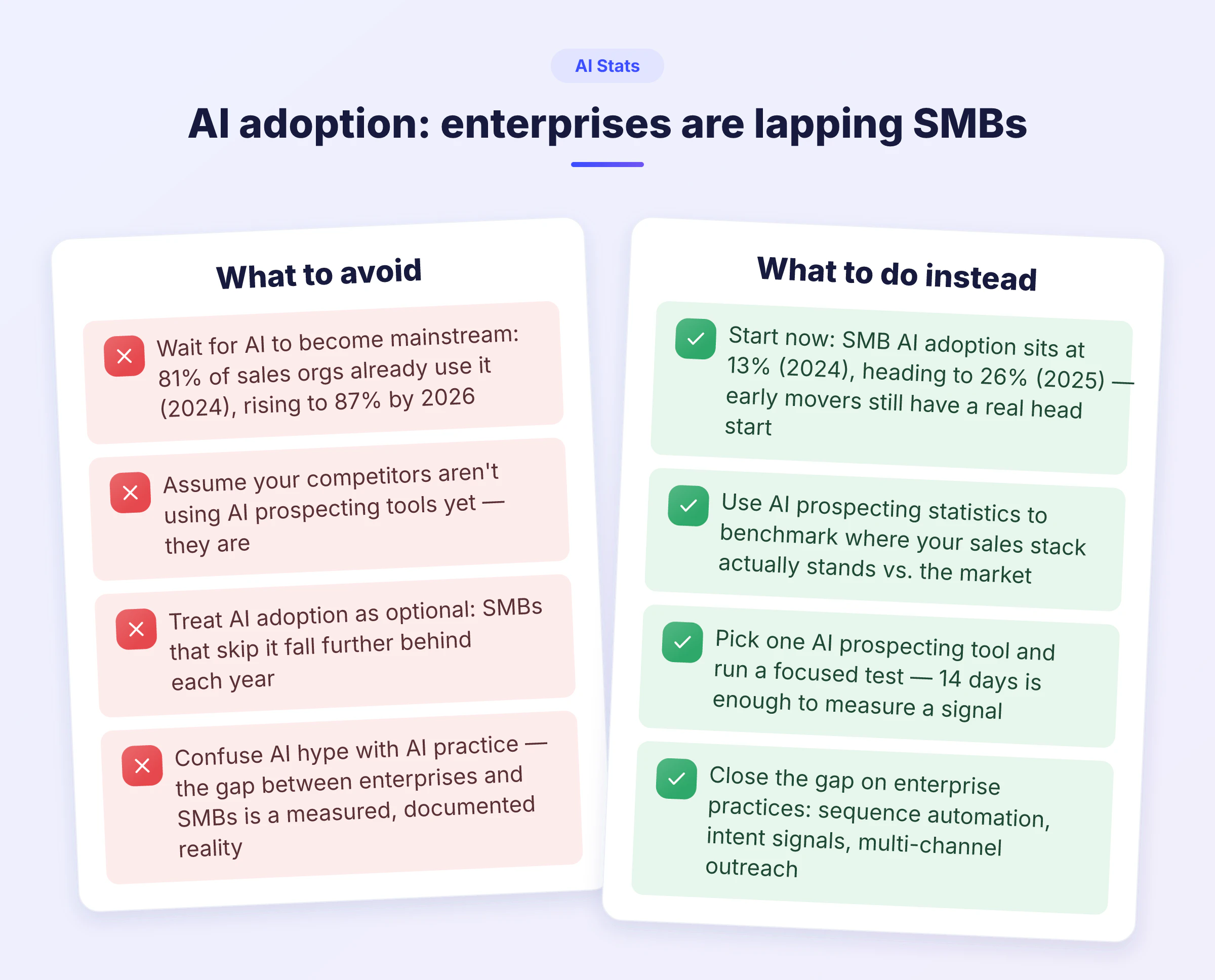
26% of French small businesses and SMEs use at least one AI tool, versus 13% a year earlier. The rate climbs with company size: 23% for companies with 1 to 4 employees, 42% for those with 50 to 249 employees (France Num 2025 barometer).
Among the AI prospecting statistics, the French number deserves a closer look. Small businesses still lag behind large companies, but doubling in one year shows the gap is closing fast. For a small business, the question is no longer whether to switch to AI, but which AI prospecting tool to choose.
On the LinkedIn side, the central platform for B2B prospecting and for any B2B lead generation strategy, the playing field keeps growing: the network claims more than 1.3 billion members on its official page. If you're new to this channel, the LinkedIn prospecting guide covers the basics.
Time saved: what AI frees up for real
It's the number one promise of AI tools, and a pillar of AI prospecting statistics. The numbers confirm it, but with big gaps between studies and one major caveat. ⏱️
AI saves sellers 4.8 hours per week, according to a Gartner survey of 210 sales leaders in 2026. But 72% of organizations reinvest little of that time in selling. Those that do are 2.2 times more likely to beat their targets.
Sales reps spend only 40% of their time selling (Salesforce, 2026). The rest goes to research, data entry and admin.
Sellers expect AI agents to cut the time spent researching prospects by 34% and the time spent writing emails by 36% (Salesforce, 2026).
AI could double selling time, estimated at only 25%, according to the 2025 Technology Report from Bain & Company. Early deployments show win rates up 30% or more.
38% of sales reps save 4 to 7 hours per week thanks to AI, according to an Outreach survey of 500 professionals in 2025.
According to these AI prospecting statistics, prospect research and message writing are the two areas where AI gives back the most time. It's also what an agent does best, as long as you give it a clear target. About twenty minutes is enough to build a clean prospecting file before you launch anything.
On LinkedIn, that time comes back mostly from searching in Sales Navigator and from writing first messages, two tasks an agent takes over entirely.
Performance: does AI improve sales results?
Saving time is good. Signing more is better, and that's where AI prospecting statistics get interesting. The studies agree on one point: AI improves results, but mostly for those who use it a lot and use it well. 🎯
Sellers who work effectively with AI are 3.7 times more likely to hit their quota. Gartner surveyed 1,026 B2B sellers in early 2024.
83% of teams that use AI saw their revenue grow, versus 66% of teams without AI (Salesforce, 2024).
Sellers who improved their reply rates with AI saw them climb 28% on average. Those who use it every day are 2 times more likely to exceed their targets, and 69% say they shortened their sales cycle by about a week (LinkedIn, 2025).
Top sellers are 1.7 times more likely to use AI agents to prospect than underperformers (Salesforce, 2026).
Teams that use AI heavily generate 77% more revenue per rep, according to Gong Labs, which combined a survey of 3,048 executives with an analysis of 7.1 million opportunities.
Be careful about reading these AI prospecting statistics as cause and effect. These studies show a correlation: high-performing teams adopt AI earlier, and AI makes them perform better. The two effects blend together. The real test is yours, on your target. To judge an agent, measure the number of meetings booked, not the number of messages sent. And track each stage of your prospecting funnel to see where AI makes the difference.
Reply rates: the prospecting numbers in 2026
Here are the benchmarks to tell whether your outbound prospecting holds up. AI prospecting statistics vary depending on the calculation method, so we spell out what's measured each time. 📬
Cold email
Cold email remains the most measured channel, and the one where sources disagree the most.
The average cold email reply rate is 3.43%. The top 10% exceed 10.7%, and 58% of replies come from the first email (Instantly, 2025 platform data).
The reply rate drops from 5.8% to 2.1% when a campaign exceeds 1,000 recipients, and goes from 3% to 4.9% with follow-ups (Hunter, 11 million emails analyzed). 71% of decision-makers cite a lack of relevance as the top reason for not replying, ahead of emails that land in spam instead of the inbox.
Measured on emails sent rather than on the email open rate, the reply rate drops to 0.45% (Belkins, 7.5 million emails in 2025). The 5.8% figure still quoted in some benchmarks comes from the old method.
The gaps between 0.45% and 3.43% mostly come from the method and the audience. Remember the common trend: the more targeted the campaign, and the more follow-up messages it includes, the better the result.
On this network, the LinkedIn response rate and the acceptance rate are much higher, because contact first goes through a connection request, often as part of a prospecting campaign.
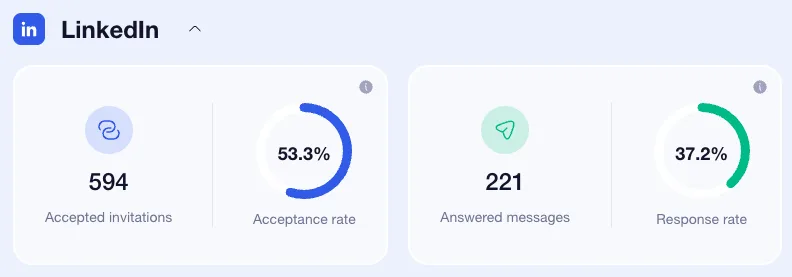
The average LinkedIn invitation acceptance rate is 26%, and the reply rate is 7.2%. An invitation with a note gets 8.2% replies, versus 5.3% without one (Belkins x Expandi, 15 million contacts in 2025).
AI-assisted messages get 7.3% replies, versus 7.0% without AI (same study). The gap is small: AI doesn't work miracles on a poorly targeted message.
42% of sales reps say social media gives the best reply rate in cold outreach, a strong argument for social selling, ahead of email (26%) and phone (23%), according to HubSpot's State of Sales 2025.
To benchmark your campaigns, our article on raising your LinkedIn acceptance rate gives more reference points by industry.
AI-written messages: do prospects tell the difference?
The question comes up often, and the numbers are more nuanced than you'd think.
67% of decision-makers don't mind receiving emails written with AI, and most spot fewer than 4 AI emails out of 9 (Hunter, 2025).
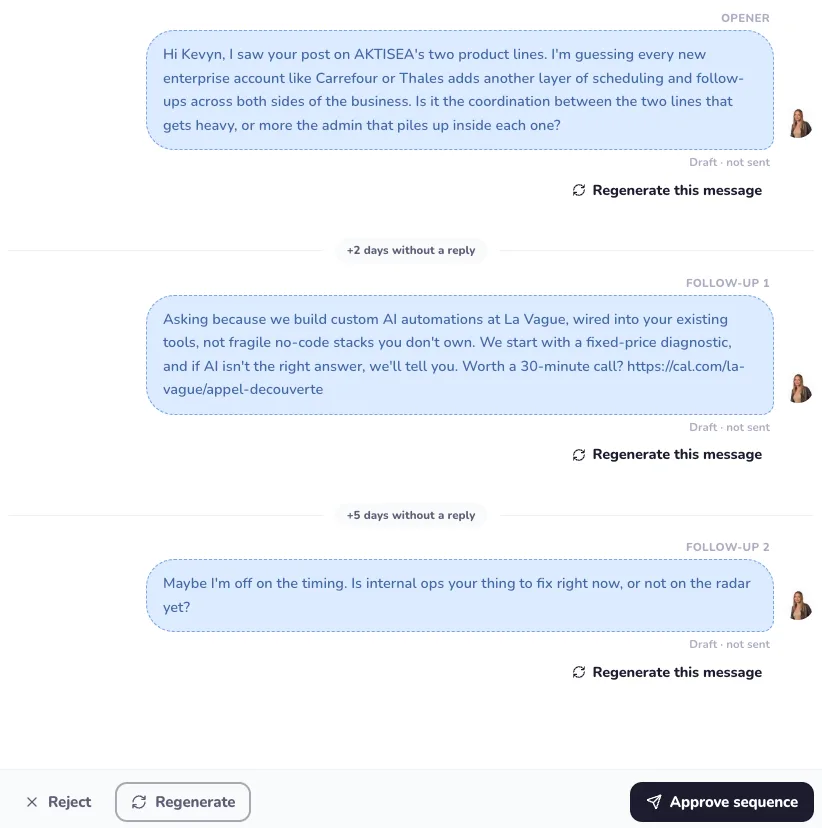
LinkedIn invitations written by a human are accepted about 12% more often than AI-generated ones, for an equivalent reply rate (Expandi, 13.2 million invitations between May 2025 and April 2026).
The practical takeaway: a prospecting message written by AI goes down well, as long as it builds on the prospect's real profile. It's the generic message, AI or not, that kills replies.
The limits of AI in prospecting, in numbers
Tool vendors rarely quote these AI prospecting statistics. Yet they're the most useful ones to decide how far to go with AI. ⚠️
69% of B2B buyers turn to a sales rep to verify the information given by AI, even though 67% prefer a buying journey without a rep (Gartner, 645 buyers surveyed in late 2025). Buyers want fewer reps, but better ones.
Only 60% of SDRs hit their quota, the lowest level ever measured by the Bridge Group in 2025. The pressure on prospecting has never been higher, which explains the interest in AI.
Two more AI prospecting statistics round out the picture. Gartner predicts that by 2028, AI agents will outnumber sellers 10 to 1, but that fewer than 40% of sellers will say they've become more productive. And according to Outreach, 45% of teams have chosen a hybrid AI and SDR model, while 22% say they've fully replaced their SDRs.
The hybrid model is the one that comes out best in the studies. We dug into it in our article on whether an AI SDR is ready to replace a human SDR. And to see how AI already fits into the network, our guide on using AI on LinkedIn covers the use cases.
AI prospecting statistics: key takeaways
The AI prospecting statistics of 2026 tell a clear story. AI is adopted by nearly 9 out of 10 sales teams and saves several hours a week. It improves results for those who use it every day and reinvest that time in selling. But buyers still want a human to validate, and generic messages still get punished, whether AI wrote them or not.
For a small team, the practical conclusion fits in one sentence: hand AI the research, the first messages and the follow-ups, and keep humans on the relationship. That's exactly what an AI prospecting agent like Waalaxy AI does, on LinkedIn: the agent finds the prospects, writes the messages, runs the conversation, and you close. 👽
FAQ: AI prospecting statistics
It's the first of the AI prospecting statistics to remember: according to Salesforce's State of Sales 2026, 87% of sales organizations use some form of AI, versus 81% in 2024. On the individual side, LinkedIn and Ipsos count 56% of reps who use it every day. In France, small businesses are a step behind:
26% of small businesses and SMEs use at least one AI tool in 2025;
that rate doubled in one year;
it reaches 42% among companies with 50 to 249 employees.
Between 1.5 and 7 hours per week depending on the study. Gartner reports 4.8 hours on average, Outreach finds that 38% of reps save 4 to 7 hours, and LinkedIn that 38% of sellers who use AI to research their prospects save more than 1.5 hours. The key point: 72% of organizations don't reinvest that time in selling, which cancels out part of the benefit.
Yes, but less than promised. Sellers who improved their reply rate with AI saw it rise 28% on average, according to LinkedIn. On LinkedIn, a Belkins and Expandi study measures 7.3% replies for AI-assisted messages, versus 7.0% without. AI helps most when it personalizes the message based on the prospect's real profile.
Around 3% to 4% according to the platforms that measure replies on emails sent: 3.43% at Instantly, 4.1% at Hunter. Belkins, which changed its method, drops to 0.45%. Two levers push the rate up:
smaller, better-targeted campaigns;
follow-ups, which take the rate from 3% to 4.9% at Hunter.
About 26% to 28%. The Belkins and Expandi study measures 26% across 15 million contacts in 2025, and Expandi 28.5% across 13.2 million invitations between May 2025 and April 2026. Invitations sent in the morning are accepted 32% to 37% of the time, versus 23% to 24% in the evening. A personalized note also improves the reply rate that follows.
Rarely, and it doesn't bother them much. According to Hunter, 67% of decision-makers don't mind receiving emails written with AI, and most spot fewer than 4 AI emails out of 9. On LinkedIn, Expandi still observes an acceptance rate about 12% higher for invitations written by a human. The signal that drives people away is the generic message.
The AI prospecting statistics say no. 69% of B2B buyers turn to a rep to verify what AI told them, according to Gartner. On the team side, Outreach counts 45% hybrid AI and SDR models, versus 22% full replacements. AI handles research, writing and follow-ups, while humans keep the relationship and the signature.