
You're fine with AI prospecting for you, but the idea of it replying to a prospect on its own ties your stomach in knots? Totally normal. An autonomous AI sales agent finds your prospects, writes your messages and runs the conversation. The real question isn't "AI or no AI". It's who approves what. Good news: you don't have to choose between controlling everything and letting go of everything. There are three levels of AI autonomy, from approving every single message to letting the agent reply on its own. In this guide, you'll get a simple grid to pick your level, see what AI handles well in a conversation (and what it should hand over to you), and learn how to give it more autonomy without burning through your target market. 👽
Autonomous AI sales agent: what are we talking about?
An autonomous AI sales agent is an AI you hand a sales goal instead of a task. You tell it "I want meetings with HR directors at SMBs", and it runs through every step on its own: finding the right profiles, writing, following up, replying. If the idea of an AI agent still feels fuzzy, keep one thing in mind. It doesn't follow a fixed script. It makes decisions at every step.
Automation, copilot, agent: what's the difference?
You hear all three words everywhere, and they don't mean the same thing. A LinkedIn automation tool runs your strategy. You pick the target, you write the automated messages, and the tool sends them at the right pace. An AI copilot helps you write, but you're the one who clicks "Send". An agent builds the strategy too.
What you do | What the tool does | Example | |
|---|---|---|---|
Automation | Target, messages, follow-ups | Sends them in the planned order | Invitation + 2 follow-ups sequence |
AI copilot | You decide and you send | Suggests a draft | Suggested message in your LinkedIn messaging |
AI agent | You set the goal and approve | Targets, writes, follows up, replies | Agent running a campaign from start to finish |
This table shows a progression. The higher you go, the more decisions the tool makes. That's exactly where autonomy becomes a serious question, because an agent that decides on its own also risks making mistakes at scale.
Human in the loop or human on the loop
Two expressions sum up the debate nicely. With a human in the loop setup, a person approves every action before it goes out. Nothing gets sent without you. With a human on the loop setup, a person supervises. The agent acts on its own, and you step in when it asks or when you spot a problem. A well-built autonomous AI sales agent lets you switch from one to the other, depending on how much you trust it and what's at stake in each conversation. 🔄

Your prospecting agent at half price, for life
€100€50/month, annual plan
Nov 27 12am to Nov 28 noon CET
Discover Waalaxy AI →14-day free trial
The 3 levels of autonomy of an autonomous AI sales agent
Forget the "manual / autonomous" on-off switch. Think in steps instead. In Waalaxy AI, they're called Assisted, Semi-autonomous and Autonomous. The difference comes down to two questions. Who approves the cold sequences (the first touchpoint), and who approves the replies to prospects (the conversation)?
Level | Cold sequences | Replies to prospects | Your role |
|---|---|---|---|
Assisted | You approve before sending | You approve before sending | You review, edit, approve |
Semi-autonomous | Sent without approval | You approve before sending | You handle the conversations |
Autonomous | Sent without approval | Sent without approval | You reply when the agent asks for help |
Assisted: you approve everything (the recommended starting point)
In Assisted mode, the agent prepares everything and you give the green light. Every sequence and every reply lands in your approval Inbox. There, you edit the message, regenerate it with an instruction or reject it. It's the default level when you create an agent, and for good reason. Each of your edits feeds the agent's Memory, which then applies your rules to all its messages. To avoid a traffic jam, the agent keeps five sequences waiting for approval at most.
Semi-autonomous: AI prospects, you keep the conversations
In Semi-autonomous mode, the agent sends the first touchpoint on its own: an invitation without a note, then up to three personalized messages. As soon as a prospect replies, approval kicks back in. You approve every AI reply before it goes out. It's the right balance when your sequences perform well and you want to keep an eye on what matters most: conversations with interested people.
Autonomous: AI sends and replies, you take over when asked
In Autonomous mode, the agent handles sequences and conversations without waiting for your go-ahead. It only reaches out to you when it's missing a piece of information (a price, your availability, a customer case study) or when the prospect is ready for the next step. You stay the one who closes. The agent brings the prospect all the way to the meeting, and you close the deal. 🤝
Can AI really reply to your prospects?
Yes, and it does a solid job on most conversations. A good chunk of prospect replies are predictable: "What is it exactly?", "Get back to me in January", "Send me more info". An autonomous AI sales agent handles these in seconds, at any hour. That matters, because response time has a direct impact on conversion (more on this in our article on lead response time).
What it handles well
Here are the situations where an autonomous AI sales agent replies as well as a busy human, and often better:
Simple questions about your offer, when the info is in its Memory.
Callback requests, with a follow-up scheduled for the requested date.
Follow-ups after silence, with nothing forgotten and no irritated tone.
Basic qualification: team size, need, timing.
Suggesting a time slot when the prospect is warm.
These repetitive tasks are exactly the ones human sales reps give up on. To go further on sorting your prospects, see how to qualify a prospect before offering a meeting.
What it should hand over to you
Some conversations are still a human job. A prospect who negotiates a price, raises a complex objection or involves three decision-makers doesn't need a fast reply. They need the right reply. Same goes for closing. Sales negotiation takes context, intuition and sometimes a phone call. A good agent spots these moments and hands control back to you instead of improvising.
Transparency: the AI never denies being an AI
It's a matter of trust, and soon a legal requirement. The EU AI regulation requires informing people who interact with an AI system, as set out in Article 50 of the AI Act. In practice, Waalaxy AI doesn't spontaneously introduce itself as an AI. But if a prospect asks whether they're talking to a bot, the agent says yes, straight up. Lying about it would wreck the relationship at the exact moment it starts.
With approval or autonomous: how to choose?
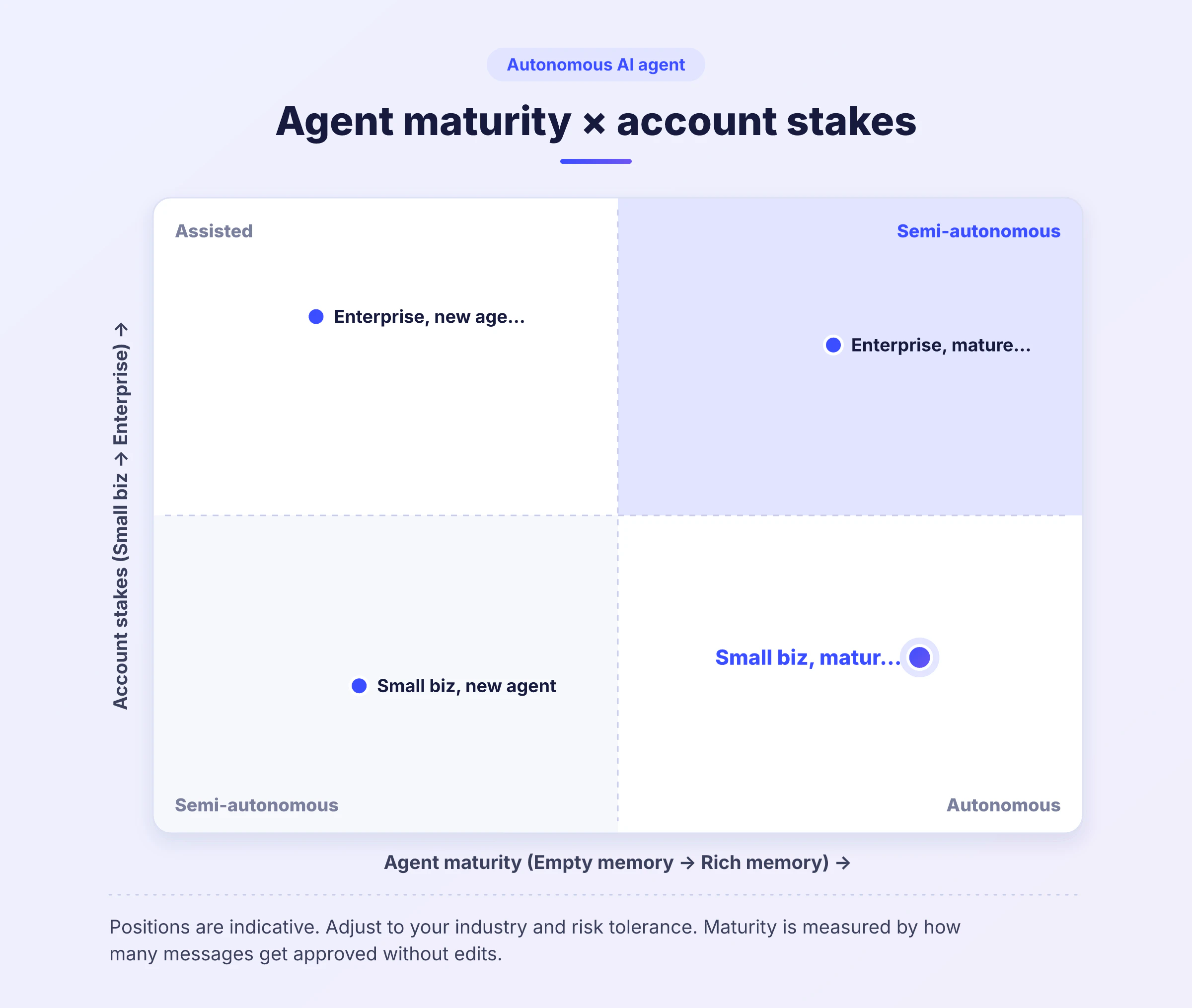
There's no single right level. The right level depends on what's at stake in each conversation and how mature your agent is. A freelancer targeting micro-businesses doesn't face the same risks as a team prospecting enterprise accounts with a six-month sales cycle.
Profile | Recommended level | Why |
|---|---|---|
Founder or freelancer getting started | Assisted, then Semi-autonomous | You learn what works and train the agent |
SMB with a simple offer | Semi-autonomous, then Autonomous | Conversations look alike, so the agent learns fast |
Sales team on a broad market | Autonomous on sequences, approval on key accounts | Volume matters, big accounts stay sensitive |
Enterprise accounts, long cycle | Assisted or Semi-autonomous | One bad reply costs too much |
Sensitive target (healthcare, legal, finance) | Assisted | Tone and accuracy matter more than speed |
If you're on the fence, ask yourself one simple question: how much would a clumsy reply to this prospect cost you? The higher the cost, the longer you keep approval on. It's the same logic as a solid B2B prospecting strategy: you don't treat every account the same way.
The risks of launching a 100% autonomous agent too early
Running an autonomous AI sales agent in full autonomy from day one is like handing your reputation to someone you hired yesterday. The most common slip-ups are well known: a made-up personalization (congratulating someone on a funding round that never happened), a generic tone that sounds robotic, or the wrong target hit at scale. That last one is the most expensive. That's why you want a clear ideal customer profile before you loosen the reins.
To understand these caps in detail, take a look at the maximum number of connections per day and the best practices to avoid LinkedIn restrictions. An agent that respects your working hours and these limits protects your account as much as your reputation.
Moving from one autonomy level to the next without risk
The right method looks like onboarding a new sales rep. They watch, they suggest, you correct, then you trust them. An autonomous AI sales agent improves the same way, as long as you give it actionable feedback.
Why start in Assisted mode
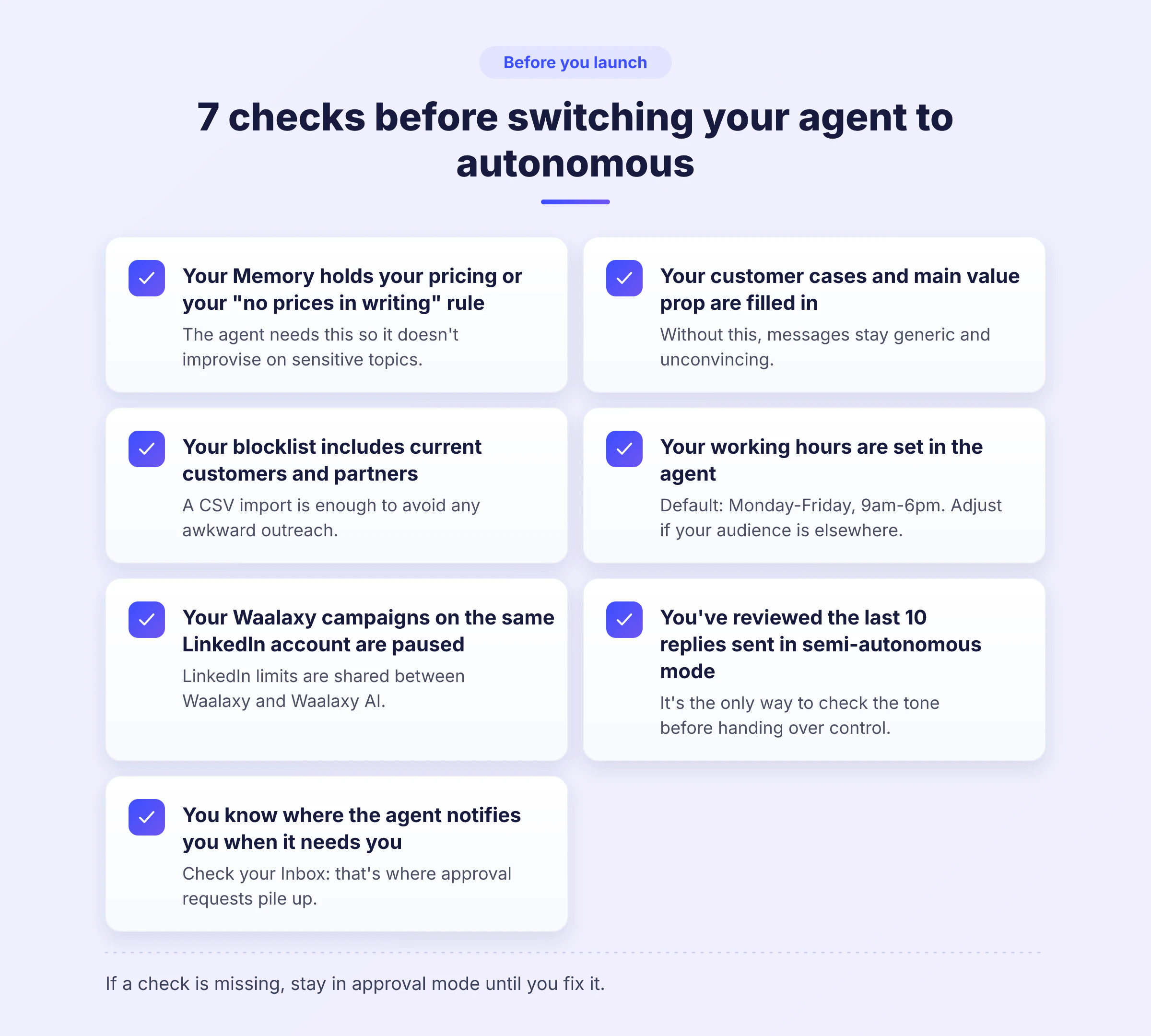
In the first few days, your input is worth the most. Every message you edit teaches the agent your vocabulary, what you actually offer and what you refuse to promise. An edit like "we never talk about pricing in the first message" becomes a Memory rule, applied to every message after that. Skip this step and you keep a generic agent. And a generic agent writes prospecting messages your prospects have already read a hundred times. 📝
The signals to move up a level
The best indicator is your edit rate, the share of messages you have to tweak before approving them. When you approve most messages as they are, your autonomous AI sales agent is ready. Waalaxy AI tracks this signal for you and suggests moving to the next level:
From Assisted to Semi-autonomous, after 20 approved messages, including 4 approvals in a row with zero edits.
From Semi-autonomous to Autonomous, after 10 approved replies, including 5 in a row with no tweaks.
These thresholds aren't a formality. They make sure the agent has seen enough cases to reproduce your judgment, and that you've had time to check it does. You're free to drop back a level at any time, for example before a campaign aimed at a new target.
The KPIs to watch once you go autonomous
Going autonomous doesn't mean closing your eyes. Check a few indicators every week, all visible in the Cockpit dashboard:
The reply rate of your sequences, compared with your Assisted period.
The share of positive replies and meetings booked.
How often the agent asks for your help, a sign its Memory is missing info.
Negative or annoyed replies, to read one by one.
If one of these lights turns red, drop back a level while you fix it. To see where you stand, compare yourself with the benchmarks in our article on LinkedIn response rate, and see how LinkedIn follow-ups affect these numbers.
How Waalaxy AI handles autonomy from start to finish
Waalaxy AI is an autonomous AI sales agent for LinkedIn, built for people who've never been trained in prospecting. You share your website URL, the agent suggests 2 to 4 targets, finds the prospects, filters out the ones who don't fit, writes a sequence for each one and then runs the conversation. The three autonomy levels apply per agent. You keep one agent in Assisted mode on your enterprise accounts and another in Autonomous mode on a broader target.
On the results side, the agent builds on more than 100,000,000 messages sent on LinkedIn through Waalaxy over 7 years. On that basis, messages written by AI get a 24.5% reply rate, versus 16.7% for classic messages. You'll find more benchmarks in our AI prospecting statistics, and a wider overview in our roundup of AI prospecting tools. 🚀
Pricing is simple: one single plan, billed per connected LinkedIn account.
Waalaxy AI
Early access
Ideal for scaling your LinkedIn prospecting safely, with higher volumes and priority support.
14-day free trial
Included:
- Unlimited agents
- Build your targets
- Automatic prospect sourcing
- Write ultra-personalized messages
- AI-managed conversations
- Unified inbox
- Live chat support
The free trial lasts 14 days, with or without a credit card, and starts as soon as you connect your first LinkedIn account. Waalaxy AI runs in the cloud, with no extension to install, and only sends messages during your working hours. You also stay in control of who should never be contacted, thanks to a blacklist you import as a CSV.
Autonomous AI sales agent: the key takeaways
An autonomous AI sales agent replies to your prospects well, as long as you give it time to learn. Start in Assisted mode to train its Memory. Move to Semi-autonomous when your sequences run without edits, then to Autonomous on targets where an imperfect reply doesn't cost much. Keep approval on high-stakes accounts, check your indicators every week, and remember that AI brings the prospect to you. You're still the one who closes. The easiest way to make up your mind is to launch an autonomous AI sales agent in Assisted mode and see what it suggests.
FAQ: autonomous AI sales agent
It's an AI that runs your prospecting from start to finish, based on a goal. Where a classic tool runs a sequence you wrote, the agent:
defines or refines the target based on your offer.
finds prospects and filters out the ones who don't match.
writes personalized messages, profile by profile.
replies to prospects until it's your turn to close.
To go further on the idea of an AI sales rep, we've broken down what this type of agent does better than a human, and where it still falls short.
No, and that's not the goal. An AI agent takes over the repetitive part: finding profiles, writing first messages, following up, answering simple questions. The sales rep keeps what creates value: understanding a complex need, negotiating, reassuring a buying committee, closing. The most effective duo is still a human who receives already-warm conversations and focuses on selling.
A rule-based agent follows conditions set in advance: "if the prospect accepts, send message 1. If they don't reply within 3 days, follow up". It's predictable, but it struggles with the unexpected. An autonomous AI agent reads the situation. It reads the prospect's reply, chooses what to answer, and decides whether to follow up later or hand things over to you. It's more flexible, which is why approval levels help you stay in control at the start.
It compares each profile with the target you approved: job title, industry, company size, location. Profiles that don't fit get filtered out before any contact, so you never write to people outside your target. During the conversation, it then asks simple qualifying questions (need, timing, team) to see whether the prospect is worth your time. The more precise your target from the start, the more reliable this sorting.
Assisted mode, hands down. It lets you:
check the agent has understood your offer and your target.
fix the tone of messages before they go out.
fill the Memory with your rules, which the agent then applies everywhere.
After a few dozen messages approved without edits, you're good to move to Semi-autonomous with peace of mind.
Yes, as long as you follow two principles. First, transparency: your prospect must be able to find out they're talking to an AI if they ask, as the EU AI regulation requires. Second, the usual B2B prospecting rules: contact professionals about their work, respect a no, and never reach out again to someone who asked you to stop. That's exactly what the agent's blacklist is for.