
Short answer: no, and that's good news. An AI SDR replaces a big chunk of an SDR's work, the part that wears everyone out: finding prospects, writing first messages, following up. It doesn't replace the person who builds trust, handles a tricky objection and gets the deal signed. 👽
In this article, we look at what an AI sales agent does better than a human, where it still stalls, and what an SDR in France costs for real. You leave with a side-by-side comparison with numbers and a hybrid model you'll be able to apply this week, even in a team of three.
What is an AI SDR?
An AI SDR is software that does the job of a Sales Development Representative: finding prospects, contacting them, qualifying their interest and booking a meeting. You'll also come across the terms AI sales agent, AI sales rep or AI BDR. They refer to the same family of tools, with different levels of autonomy. They extend the logic of AI lead generation tools, applied this time to the whole prospecting chain.
What it does in practice
A complete agent runs through five steps without you lifting a finger, or almost. 🛰️
It defines or refines your target based on your offer.
It sources the matching prospects, on LinkedIn or in a database.
It writes a first message tailored to each profile.
It follows up at the right time and replies to messages.
It suggests a time slot when the prospect is warm.
Not every tool goes that far. Some stop at writing and leave the replies to you. We ranked the solutions on this criterion in our comparison of AI prospecting tools.
AI SDR, copilot or automation: where's the line?
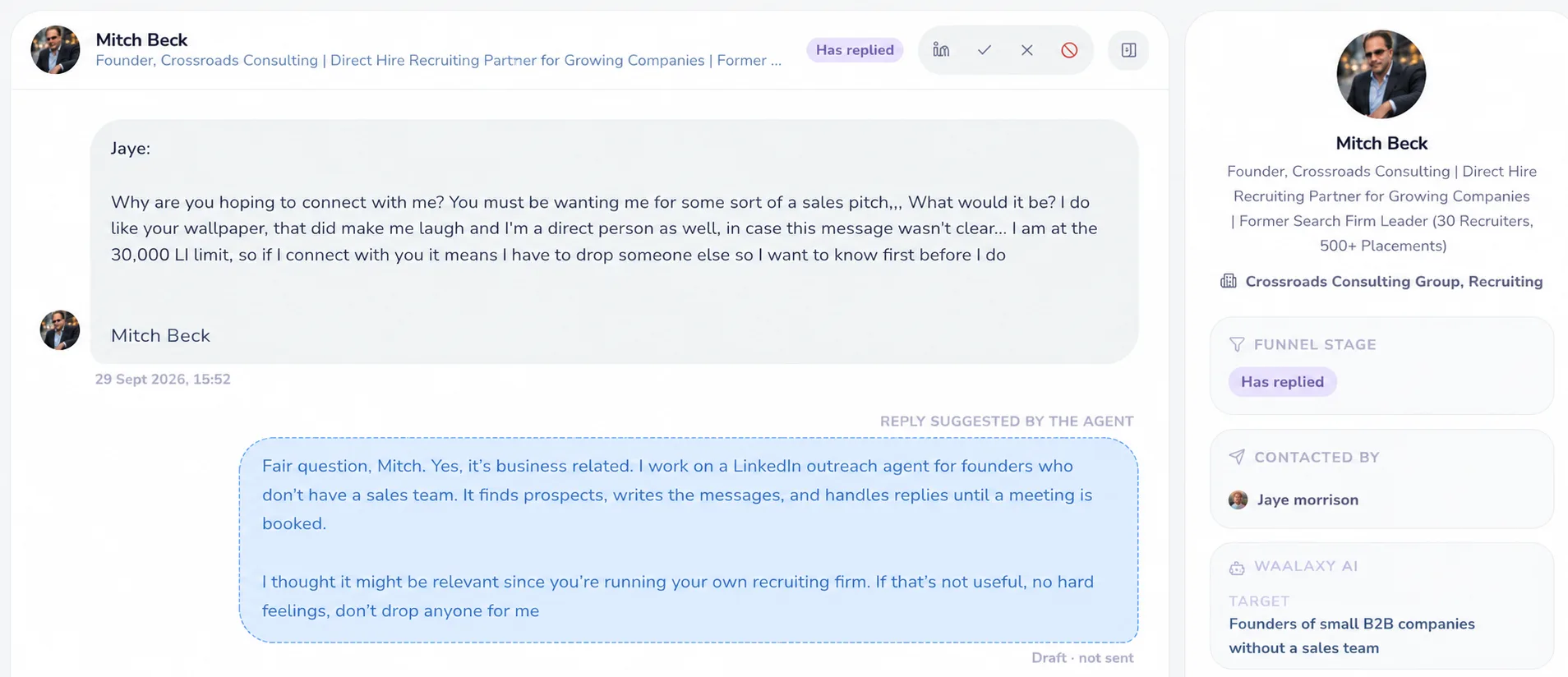
The line shows up when the prospect replies. With a LinkedIn automation tool, the sequence stops and you take over. With a copilot, the AI suggests a reply that you send. With an AI SDR, the agent replies itself, or asks you for the missing info before doing so.
What an AI SDR does better than a human SDR
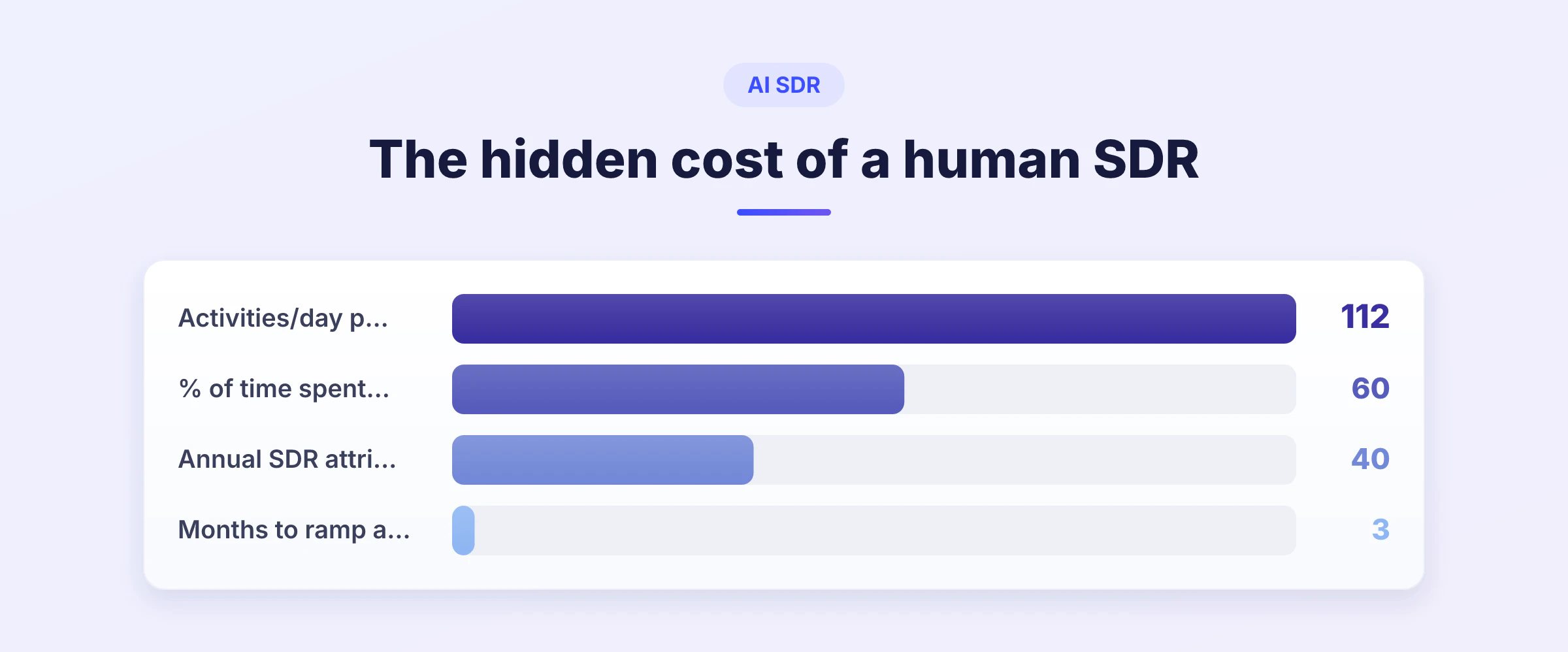
Let's start with the numbers. According to the Bridge Group's 2025 report on SDR models, an SDR performs a median of 112 activities per day: 44 calls, 41 emails, 19 LinkedIn actions and 8 others. All that for 4.1 qualified conversations. The rest is research, data entry and follow-ups.
And that time isn't spent selling. Salesforce's State of Sales 2026 estimates that reps spend 60% of their time on non-selling tasks. That's exactly where AI is strongest. ⚡
✅ Volume without fatigue. The agent treats each prospect with the same attention, from the first to the three-hundredth.
✅ Consistent follow-ups. No LinkedIn follow-up message forgotten because Friday was busy.
✅ Personalization at scale. Every LinkedIn prospecting message builds on the prospect's real profile, not on a template with a first name.
✅ Availability. A prospect who replies at 10 p.m. gets an answer without waiting for the next day.
✅ Profile screening. A prospect list built by hand contains 30% false positives. An agent that analyzes each profile before reaching out sets aside the ones that don't match your target.
These gains show up first on your LinkedIn prospecting. It's the channel where messages are the most personal and where writing takes the longest. If you're starting from scratch, the guide to prospecting on LinkedIn lays out the basics to know before handing anything to an agent. And message quality weighs heavily: on Waalaxy, the average reply rate of campaigns is 16.6%, while the best strategies reach 47.8%. Waalaxy AI is built on those top-performing strategies.
Where the AI SDR still falls short
The market got a cold shower in 2025. A TechCrunch investigation into 11x, one of the best-funded AI SDRs, revealed customer logos displayed without permission. ZoomInfo, which had tested the tool for a month, said the product had performed "significantly worse" than its own SDRs. The lesson goes beyond a single vendor: full autonomy without a framework disappoints.
Relationships and complex objections
A prospect who writes "we already have a provider, but we're not thrilled" expects a real conversation. You have to dig, reassure, sometimes go off script. A poorly briefed agent improvises a generic answer, and lead qualification suffers. That's where humans keep a head start.
Fake meetings and deliverability
Two other pitfalls keep coming up in field feedback. First, an agent pushed for volume books meetings with poorly qualified people, which lead nowhere. Second, large cold email sends damage your domain's sender reputation. On LinkedIn, the risk is different but real: too many actions in a short time expose your account.
To put market numbers in context, our AI prospecting statistics separate the reliable studies from the rest.
AI SDR vs human SDR: the numbers side by side
Let's get to the heart of the matter: cost. In France, a junior SDR earns between €24,000 and €30,000 gross per year according to Hellowork, excluding variable pay. Licorne Society, which recruits for startups, puts a junior's total compensation between €36,000 and €47,000 including variable pay. Add employer payroll taxes, between 25% and 42% of gross salary according to Keobiz. 💸
Cost item | Junior SDR in France | AI SDR |
|---|---|---|
Compensation | €36,000 to €47,000 gross/year, variable included | From $144/year (Kanbox Starter) to $45,000/year (11x Growth). Waalaxy AI: €1,200/year per LinkedIn account, €960 billed annually |
Payroll taxes | + 25% to 42% of gross | None |
Estimated total cost | ≈ €45,000 to €67,000/year | Depends on the tool and the volume |
Ramp-up time | 3 months on average | A few days of setup |
Average tenure | 1.9 years | Not applicable |
Annual attrition | 40% median | Not applicable |
Sources: Hellowork, Licorne Society and Keobiz for France, Bridge Group 2025 for ramp-up time, tenure and attrition (US SaaS market). The total cost is an estimate that applies payroll taxes to total compensation.
The raw math favors AI, but it's not enough. An SDR who stays 1.9 years and spends 3 months ramping up works at full speed for about 19 months. An agent doesn't quit, but it doesn't sign deals either. The right calculation happens in your sales pipeline: how many qualified meetings each option brings into it.
Splitting the tasks, line by line
Rather than picking a side, look at who handles each task of the business developer job best. 🎯
Task | AI SDR | Human SDR |
|---|---|---|
Define the ideal target | Suggests a target based on your offer | Approves and adjusts |
Source prospects | The fastest | Too slow at scale |
First message | Personalized for each profile | Better on strategic accounts |
Follow-ups | Perfectly consistent | Often forgotten |
Simple questions (price, lead time, features) | Answers if it has been given the info | Answers |
Complex objections | Limited | The strongest |
Meetings and closing | Suggests a time slot | Leads the conversation and signs |
If your target isn't clear yet, start there: an agent amplifies a good target and wastes a bad one. A lead scoring grid helps you set it up in about twenty minutes.
The hybrid model: getting AI and your team to work together
Most field feedback points to the same model. AI handles the volume, humans handle the relationship. For a small team, here's how to set it up without turning everything upside down. 🪐
1. Start in approval mode
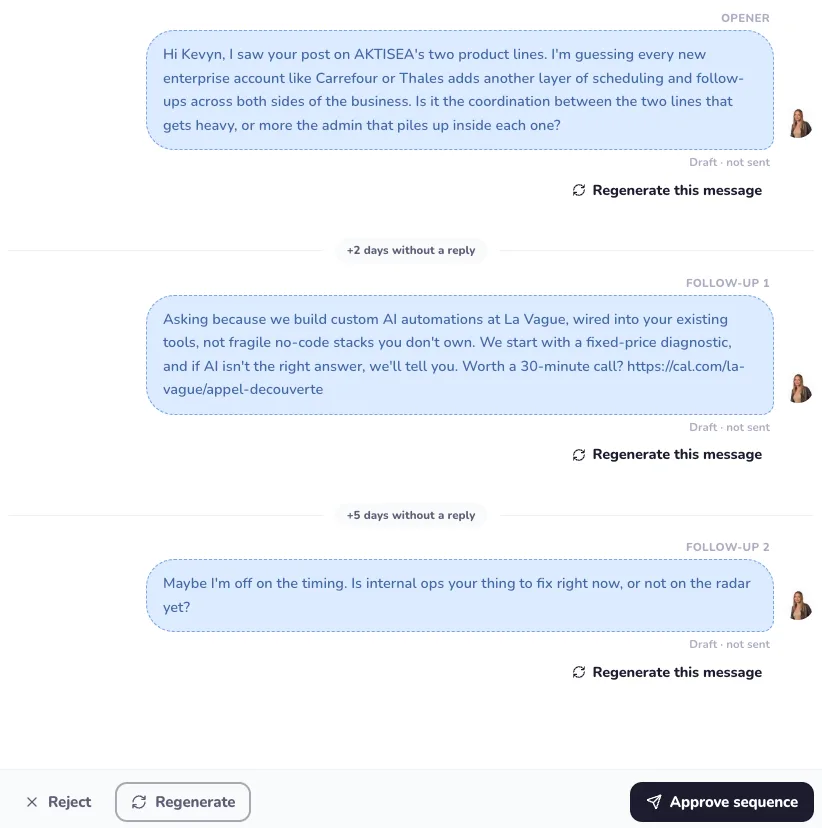
For the first few weeks, keep control of the replies. That's the principle behind Waalaxy AI's approval mode: you approve every sequence and every reply before it goes out, by editing it, regenerating it with feedback or rejecting it. When the agent is missing info to reply to a prospect, it doesn't guess, it hands the conversation back to you. Once you trust it, you switch to autonomy mode: the agent sends on its own and calls on you when it needs you.
2. Feed the agent your feedback
An agent with continuous learning gets better with every correction. Take 10 minutes a day to review its replies and fix the ones that sound off. In Waalaxy AI, you also add your prices, your lead times and your usual objections to the Memory: short instructions the agent applies to all its messages, on top of what it picks up from your corrections. It's the same principle as automated LinkedIn follow-ups: you set the rules once, then the tool applies them.
3. Keep humans on the key moments
As in any good lead management system, decide in advance what goes up to a human: a quote request, an objection about a competitor, a strategic account. The agent handles the rest. On LinkedIn, this split often happens through reply management in a single inbox, where everyone sees who's in charge. In Waalaxy AI, the Inbox gathers every conversation and every message waiting for approval. On the automation tool side, Inbox Waalaxy works on the same principle.
4. Be upfront about it
Since August 2, 2026, Article 50 of the EU AI Act requires informing people that they're interacting with an AI system, from the first interaction, unless it's obvious. An agent that replies to your prospects on its own falls under this rule. Have a lawyer check your use case, and plan a clear notice in your automated messages.
AI SDR: key takeaways
An AI SDR doesn't replace your SDR, it replaces the part of their job that has nothing to do with selling. It sources, writes, follows up and answers simple questions, for a cost nowhere near a fully loaded salary of €45,000 to €67,000 per year in France. Humans keep the relationship, the complex objections and the signature.
The right starting point for a small team: an agent in approval mode, fed with your feedback, then given more freedom as it learns. The agent finds the prospects, writes the messages and runs the conversation, you close, and you take back control whenever you want. 👽 To compare the options available, our page on the AI prospecting agent shows how Waalaxy AI goes about it.
FAQ: AI SDR
It's software that takes over a sales rep's prospecting work: finding prospects, contacting them, following up and replying all the way to the meeting. It relies on a language model to write messages tailored to each profile. Depending on the tool, it acts alone or asks for your approval before sending. The most advanced ones learn from your corrections to get more accurate week after week.
It replaces part of the work, not the rep. The Bridge Group counts 112 activities per day for an SDR, a large share of which is research, writing and follow-ups: that's what AI absorbs. Relationships, business negotiation and closing stay human. The model that works best combines both:
the agent fills the calendar;
the rep qualifies and signs.
It transforms them more than it eliminates them. An Emergence Capital study shared by SaaStr shows that 36% of B2B software companies cut their SDR teams in 2025, but 44% kept them and 19% grew them. The job is shifting toward qualification and relationships, with fewer repetitive tasks and more high-value sales skills. An SDR who knows how to run an AI agent becomes more productive, not useless.
Anywhere from about ten dollars to several thousand per month. A LinkedIn agent like Kanbox starts at $12 per month, Gojiberry at $99, Waalaxy AI costs €100 per month per LinkedIn account, and 11x asks for $3,750 per month with an annual commitment. For comparison, a junior SDR in France costs between €45,000 and €67,000 per year fully loaded. Always compare the cost per qualified meeting, not the sticker price.
Yes, as long as you respect two frameworks. GDPR and the CNIL rules allow B2B prospecting if the message relates to the person's job and they're able to opt out easily. Since August 2, 2026, the AI Act requires informing people that they're interacting with an AI, unless it's obvious. Have a lawyer check your use case if your agent replies to prospects on its own.
The SDR (Sales Development Representative) often handles inbound leads or provided lists, and qualifies them. The BDR (Business Development Representative) goes out to find new prospects through outbound. In small French teams, both roles often merge under the title of business developer. An AI SDR mostly covers the outbound part: sourcing, first contact and follow-ups.
Keep control at first and give the agent context. Three simple rules:
start in approval mode to approve the replies;
give the agent your prices, lead times and frequent objections;
send quote requests and strategic accounts up to a human.
Then measure qualified meetings, not the number of messages sent.