
Podawaa pricing reads on two axes, not one. There are three volume tiers, which you expect, and above all two operating modes whose price gap runs from single to double.
Here is the full grid, what each line actually covers, and how to choose without paying for something you do not need.
The full pricing grid
Same reaction caps in both modes, but not the same number of comments and not the same price. The plans and features in detail sit on Podawaa's official site.
Tier | Reactions / post | Community | Private |
|---|---|---|---|
Scale | 50 | 29 € a month, 5 comments | 59 € a month, 10 comments |
Accelerate | 100 | 45 € a month, 10 comments | 89 € a month, 20 comments |
Dominate | 250 | 69 € a month, 20 comments | 159 € a month, 50 comments |
Campaigns are unlimited on all six plans, annual billing takes 15 % off, and there is a free entry point on the Community side plus a 7 day trial with no card.
Where the gap between the two modes comes from
This is what the grid alone does not explain. The two modes are not selling the same thing.
Community | Private | |
|---|---|---|
Chrome extension | Required | None |
Your LinkedIn account | Likes and comments back on other members' posts, with no way to switch it off | Never used, no connection |
Engine | Your browser, which has to stay open | Fully cloud based, around the clock |
On Community you pay less because you return the service you consume. Your account is part of the crowd that reacts. On Private you pay to give nothing at all.
At the same reaction volume the gap is +103 % on Scale, +98 % on Accelerate and +130 % on Dominate. But Private also doubles the comment count at every tier, so the premium does not only buy discretion.
What the cap actually covers
The number quoted, 50, 100 or 250, is a cap per post, not per month. A Scale plan gives you up to 50 reactions on every post you publish, as many times as you publish.
That is what makes a comparison with a metered system misleading: the cost per post drops as you publish more. At three posts a week, a Community Scale plan works out under 2.50 € per amplified post.
The only real ceiling is the reaction count on a given post. The rest is a matter of not aiming too high, which we cover in our LinkedIn pod best practices.
What each tier adds
Beyond volume, the tiers do not unlock the same features.
Tier | What it adds |
|---|---|
Scale | Priority queue and an analytics dashboard |
Accelerate | Comment generation, priority support, and automatic amplification of new posts |
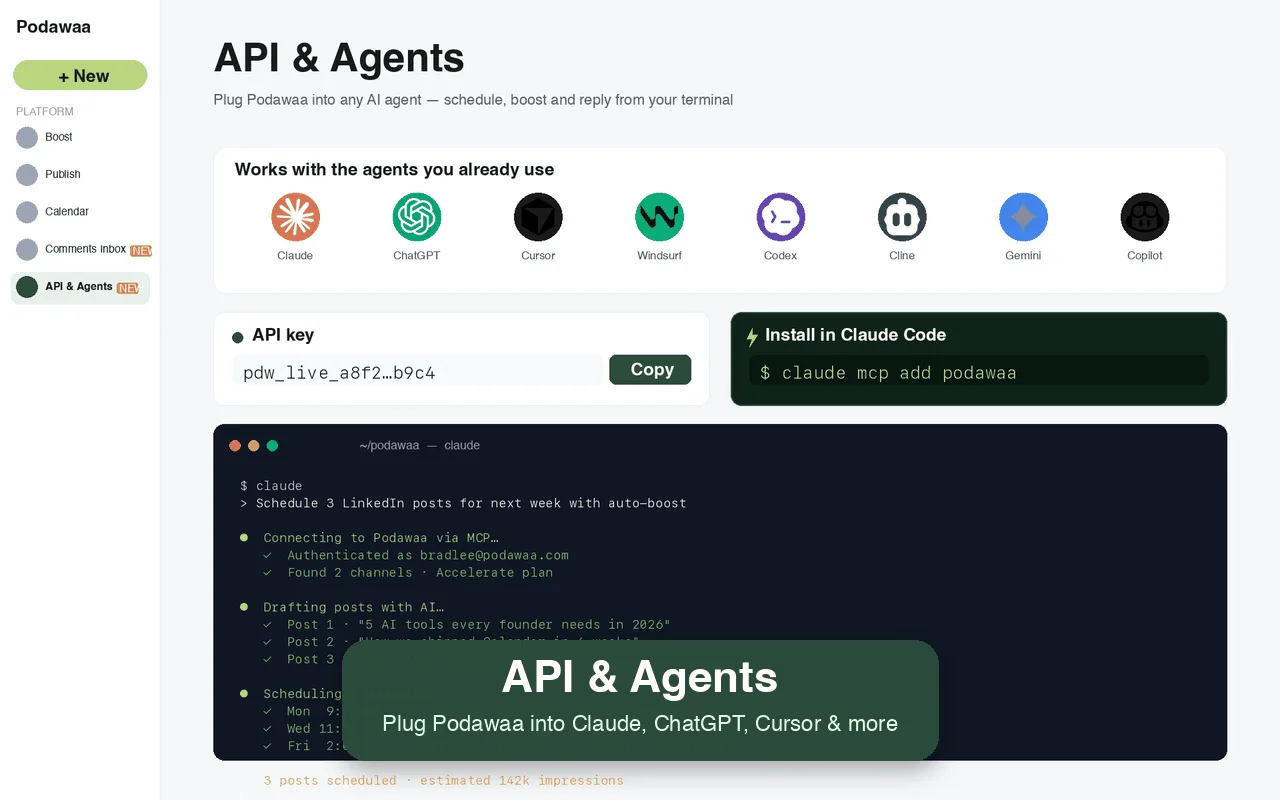
Dominate | Repost boost, dedicated manager, public API and Claude Code integration |
Two features deserve attention before you pick. Automatic amplification of new posts only appears from Accelerate upward. And the public API, with the command line integration, belongs to the top tier only.
Multiple accounts and agency use
Multi account is priced on the Private side only, which makes it the agency offer in practice: 19 € per extra account on Scale, 39 € on Accelerate, 59 € on Dominate.
For an agency running client posts the logic holds: client accounts are never used to engage on third party content, so nobody's reputation is committed without their say.
How to choose without getting it wrong
Three questions settle it, in this order.
Can your account like other people's posts? If not, it is Private, and the price doubles. That question comes before all the others.
How many reactions does your best post get naturally? The tier should stay in the same order of magnitude, otherwise the gap shows.
Do you publish often enough? Below one post a week a monthly subscription pays for itself badly.
Starting on the low tier is still the best approach. Moving up is instant. Coming back down after your audience got used to 250 reactions a post is much less so.
Comparing a visibility budget with an outreach budget
An amplification line item is hard to judge on its own. The right question is not what the subscription costs, but what a useful conversation costs at the end of the chain.
To place the order of magnitude you have to look at the other possible line. Waalaxy is a B2B LinkedIn outreach automation tool, built by the team behind this blog: from a list of profiles it runs invitations, messages and follow up emails, then gathers the replies — see the full Waalaxy subscriptions for a price comparison. It does not bring people to you, it goes and gets them.
The two budgets do not cancel out, they cover two different gaps. One buys audience for content you already wrote. The other buys time on follow up work nobody enjoys doing by hand, and it is measured in meetings, not impressions.
Waalaxy claims 200 000+ users and 4.8/5 across 5 000+ reviews, with a free 14 day trial and no card. Enough to compare both line items on evidence, once you have defined your LinkedIn audience.
The right calculation is done on cost per result, not cost per subscription.
FAQ: Podawaa pricing
Yes, on Community mode, with a free entry point and a 7 day trial with no card on the paid plans. The trade for free is that your account reacts to other members' posts.
No, it applies per post. Campaigns are unlimited, so the more you publish, the lower the cost per amplified post.
Because your account is never used to engage on other members' posts, and because the engine runs in the cloud with no extension. Private also doubles the number of comments per post.
Yes, on the Private side only, at 19, 39 or 59 € per extra account depending on the tier. That is the setup made for agencies and teams.
It takes 15 % off. On regular use that is worth having, but validate your tier monthly first, because moving down a tier is harder than moving up.
The full breakdown of the modes and settings is in our Podawaa FAQ.