
LinkedIn pods win you views, or slowly destroy your reach. The difference is not the tool, it is how you use it.
Here are the best practices that separate a post that takes off from an account the algorithm stops testing. They apply to Podawaa as to any other engagement system.
LinkedIn pods: what the algorithm actually reads
Before the settings, you need to understand what LinkedIn watches in LinkedIn pods. It does not look for a tool by name, it reads behavioural patterns. Three signals damage your distribution, whatever means you use. The plans and features in detail sit on Podawaa's official site.
The same accounts reacting to every single post you publish.
Reactions packed into a time window too tight to look like natural discovery.
Generic comments from profiles unrelated to your topic.
The penalty is not a ban, it is erosion. Your likes hold steady and your reach shrinks, with no notification. LinkedIn simply learned your content only interests a small circle. We covered the signals it does reward in our piece on LinkedIn reactions.
Spread rather than concentrate
The first best practice for LinkedIn pods is also the least intuitive: slower is better. A hundred reactions in ten minutes make a spike no organic discovery produces. Fifty reactions spread over two days look like real reading.
Podawaa offers three delivery speeds, and the most aggressive is not the one it recommends. Standard delivery, spread over one to six hours, is aimed at the famous first hour of a post, the one where the algorithm decides whether to widen or not.
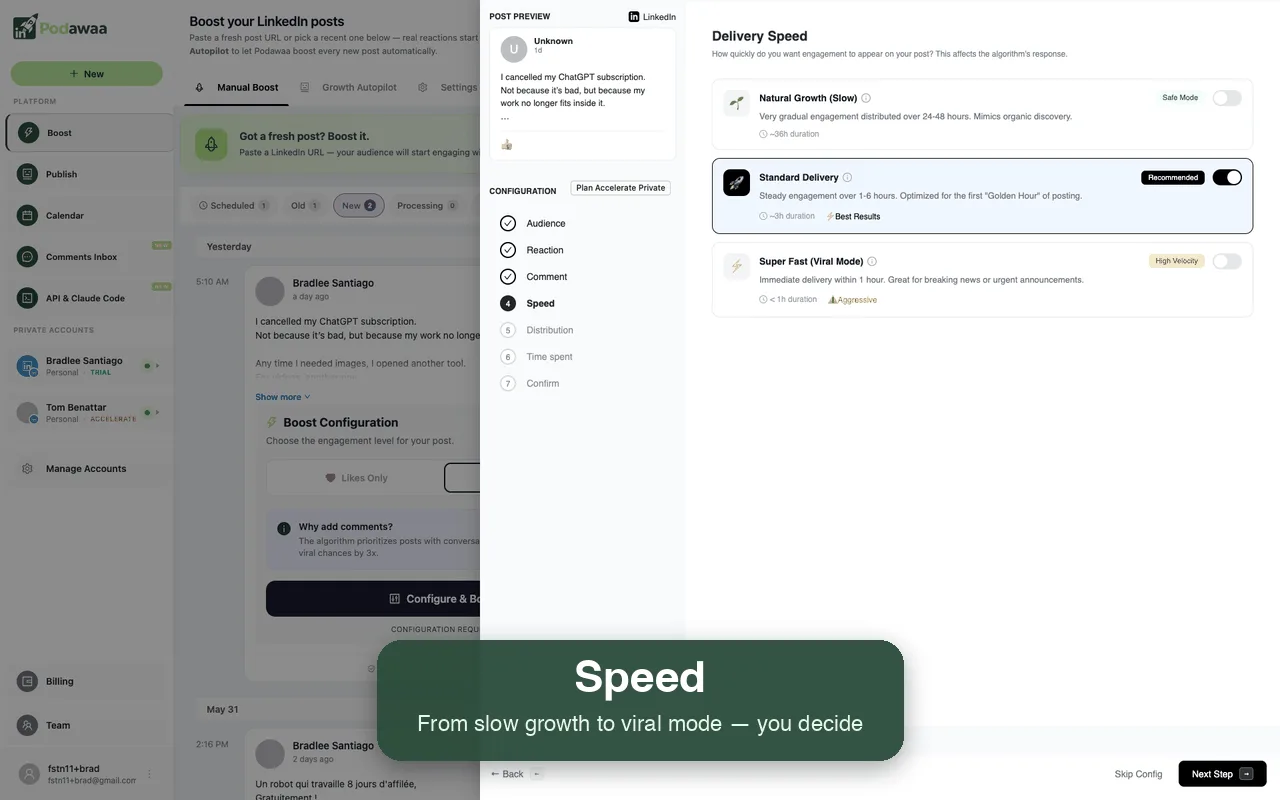
The fastest mode, under an hour, has a precise use: an urgent announcement, news that will not hold for the day. Pulling it out for an ordinary post means paying for a suspicious signal with nothing in return.
Pick a proportionate volume
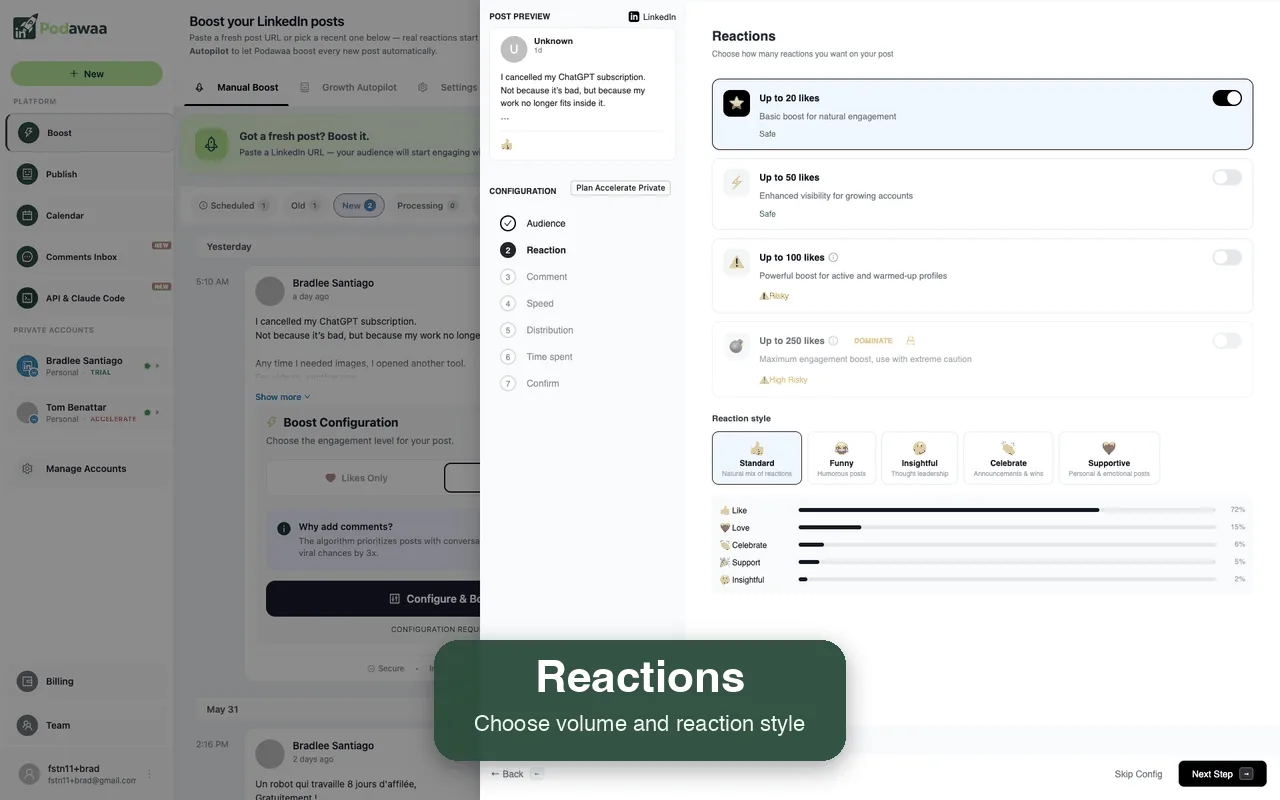
Volume is the worst used setting in LinkedIn pods. An account with 800 connections getting 250 reactions on every post sends an incoherent signal. The volume has to stay plausible for your audience, not maximal.
Podawaa does display the risk next to each tier, which is rare and deserves to be followed to the letter.
Volume | Labelled as | For whom |
|---|---|---|
20 to 50 reactions | Safe | Most accounts, in regular use |
100 reactions | Risky | Already active profiles, with a reach history |
250 reactions | High risk | Exceptional cases, to be spaced out |
Vary the accounts and the shapes
The easiest pattern to spot is repetition. Same people, same hour, same reaction type: three posts are enough to draw a signature.
Two settings help. Reaction style first, which spreads across like, support, celebrate and curiosity instead of sending everything to the blue thumb. Distribution curve next, which changes the shape over time: front loaded, bell, split into two waves, or random.
That last option exists explicitly to avoid predictable behaviour. It is a useful admission: perfect regularity is itself a signal.
Care more about comments than likes
In LinkedIn pods a like weighs little. A comment weighs a lot, and a hollow comment weighs against you. « Great post » repeated by fifteen profiles unrelated to your job looks exactly like what it is.
Three rules hold the quality. Write comments that answer the content, not the fact that it exists. Keep the number to what a real thread would produce. And leave room for spontaneous replies, which often arrive after the first wave.
The first comment is a case apart, and underused: it appears in other people's feeds as separate activity, so it creates a second distribution for the same post.

Target people whose opinion counts
Audience relevance weighs as much as volume. A developer commenting on an engineering post beats ten random profiles, because LinkedIn uses that to understand who your content is for.
Badly targeted engagement does worse than nothing: it teaches the algorithm an audience that is not yours, and it will then have you distributed to the wrong people. To lay the groundwork, we wrote a guide on LinkedIn audience.
Podawaa builds its audiences through Smart Groups, generated from the account's interests, with targeting by language and by industry. That is the setting to tighten first, before touching volume.
Do not amplify just any post
A best practice people forget: not every post deserves it. Amplifying weak content mostly speeds up the discovery of its weakness, and burns budget.
The useful reflex is to judge the hook first. Podawaa gives a viral potential score out of 100 that rates the first two lines, the ones deciding the click on « see more ». If the score is low, rewriting the hook pays more than any reaction volume.
Same logic for rhythm: better to amplify one post a week than five average posts. If you want to organise that, we compare the methods in our guide on scheduling LinkedIn posts.
Fine tuning does not fill a calendar
You have just read six settings to watch so you do not damage your reach. That is real work, and it produces a real result: more people read what you write. It stops there.
Moving from reading to conversation is another job, the one Waalaxy does, the LinkedIn outreach tool built by the team behind this blog. The principle fits in a sentence: you hand over a list of profiles, it chains invitation, messages and follow up emails, and brings the replies back into a single queue.
The point is not volume, it is less mental load. Nobody keeps the table of who accepted, who did not reply, and who has been waiting six days for a follow up. Campaigns run from the Cloud, even with your computer off.
A well dosed pod makes you readable to a wider audience.
An outreach sequence makes you reachable by the people you targeted.
The two are worked separately, with different metrics: reach on one side, reply rate on the other.
If you spend more time adjusting engagement tiers than talking to people, the call has already been made.
FAQ: LinkedIn pods
The risk is not account suspension, it is algorithmic. Repetitive use makes your reach drop with no warning, while the like count stays identical. You control it through volume, spread over time and the relevance of the profiles reacting.
A volume that is plausible for your audience. If your best organic post does 40 reactions, asking for 250 creates a visible gap. Start between 20 and 50, then move up in steps over several weeks.
Comments, as long as they have substance. They weigh more than reactions and restart distribution, but generic comments from off topic profiles produce the opposite effect.
In the first hour after publishing. That is the window when the algorithm tests your post on a first sample and decides whether to widen or not.
You paste your post URL, pick a volume and a delivery mode, and real profiles react. The detail of the plans and settings sits in our Podawaa FAQ.