
You want more conversations on the phone without hiring three more reps. Good news, that is exactly what a parallel dialer is for. Less good news, there are five serious options on the market, and they are not built for the same teams at all.
We compare Nooks, Orum, ConnectAndSell, Koncert and Skipcall on what actually drives your decision: the number of lines, the real price, whether telephony is included. You leave with a choice, not a list.
Ok, but what is a parallel dialer?
A parallel dialer is no longer a dialer feature. It has become a product category of its own.
The principle fits in one sentence: the software calls several numbers at the same time, filters out voicemails, switchboards and dead lines, and only puts you through to the first person who actually picks up. You stop dialing, you stop waiting for the ring, you talk.
On a cold B2B list, the vast majority of your calls land on voicemail or a switchboard. With a classic dialer, you spend the day listening to beeps. With four lines in parallel, the dead time disappears, and with it most of the fatigue of cold calling. The gain does not show up in the number of calls in your reporting, it shows up in the number of real conversations in your day.
Not to be confused with the power dialer, which goes through numbers one by one automatically, or with the predictive dialer, which dials more numbers than you have reps available and therefore produces abandoned calls.

Get a prospecting plan built for your business
From your website, our AI identifies your targets, their problems, and writes your outreach messages. Zero effort.
30 sec · 100% free
How we compared the parallel dialers
Five criteria, because these are the five that change a buying decision:
The number of simultaneous lines. The more you have, the more conversations you string together. But the more you also risk abandoning calls and getting your numbers flagged as spam.
The public price per user. From €75 to $250 per user per month, for an almost identical promise.
Telephony included or not. Most of these tools do not sell the numbers. You need a separate VoIP provider: second contract, second invoice, second support desk.
Features, setup and ease of use. A dialer on its own is not enough. What counts is what comes with it, how long it takes to get running, and what it asks of your reps every morning. A powerful tool nobody opens is worth nothing.
CRM integrations. Without two-way sync with your CRM tools, the time you save on calls you lose again on data entry.
All data comes from the vendors' official sites and from public sources, checked on 21 October 2026. When a vendor does not publish something, we leave the cell empty rather than filling it with a guess.
The 5 parallel dialers compared in one table
Solution | Simultaneous lines | Public price per user per month | Seat minimum | Telephony sold by the vendor | Positioning |
|---|---|---|---|---|---|
Nooks | 5 | Not published | Not published | Not published | Full AI platform for revenue teams, 1,800 customer teams claimed |
Orum | 10 | Not published | 9 | Not published | The original parallel pure-play, around $36M estimated ARR |
ConnectAndSell | Not published | Not published | Not published | Not published | Software plus human agents who get past switchboards |
Koncert | 4 to 5 by tier | Not published | Not published | Yes, via Koncert Phone | US compliance angle, TCPA and SOC 2 Type II |
Skipcall | 4 | €75, or €60 on annual billing | 1 | Yes | Parallel dialer and business phone system in a single contract |
The first lesson from this table is not a number, it is an absence. Out of five vendors, only one displays its pricing. The other four put you through a quote, and Orum adds a 9-seat minimum on top: if there are six of you, you are not even in the target.
The 5 best parallel dialers in 2026
Here is a closer look at each parallel dialer, from the most complete platform to the most accessible option. If you are also looking beyond the phone, check out our list of sales prospecting tools.
1. Nooks, the platform that absorbed the dialer
Nooks is the most visible name in the category, and also the one that has changed the most. The product started from the parallel dialer and the virtual salesfloor, that virtual trading floor where your SDRs call together and the manager can listen in and whisper live. Today it presents itself as revenue infrastructure in four modules: AI sequencing, AI dialer, signals and intelligence, AI coaching.
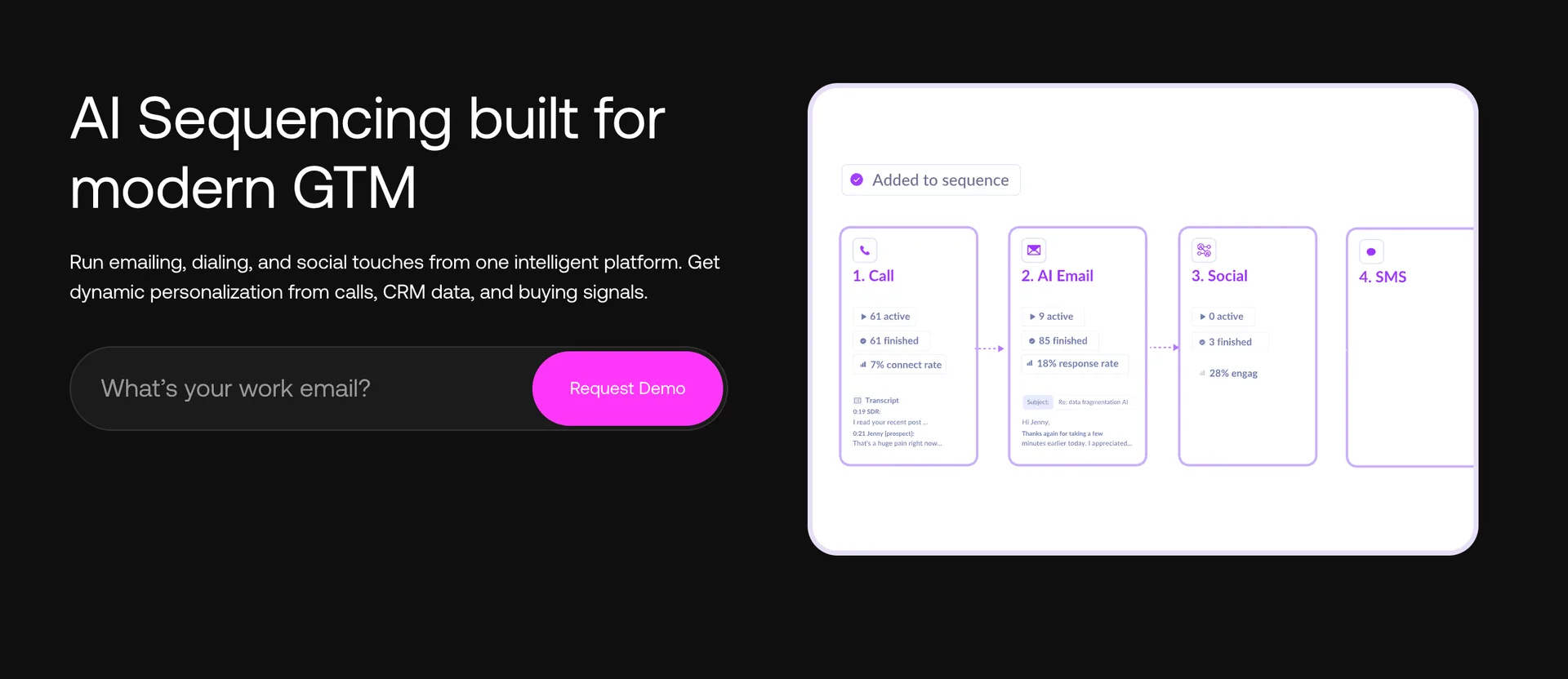
What works. The dialer calls up to 5 numbers at once. The vendor claims more than 1,800 customer teams and a 4.8 rating from over 1,700 reviews, with strong US tech logos. Live coaching and call summaries are among the most polished on the market. If you have fifteen junior SDRs to ramp fast, this is the most complete offer.
What hurts. No public pricing: you do not know what it costs until you have talked to a rep. And the scope has widened so much that the dialer is now one module out of four. You buy a platform, not a dialer. Like most US pure-plays, Nooks does not sell telephony: budget for a separate number provider.
Who it is for. Teams of 10 seats and up, US market, platform budget accepted.
2. Orum, the benchmark that lost ground
Orum largely invented the category. Founded in 2018 in San Francisco, the company raised $25M in Series A then $22M in Series B. Sacra estimates its annualized revenue at around $36M as of May 2025, across some 1,200 customers. That is the largest volume in the pure-play market.
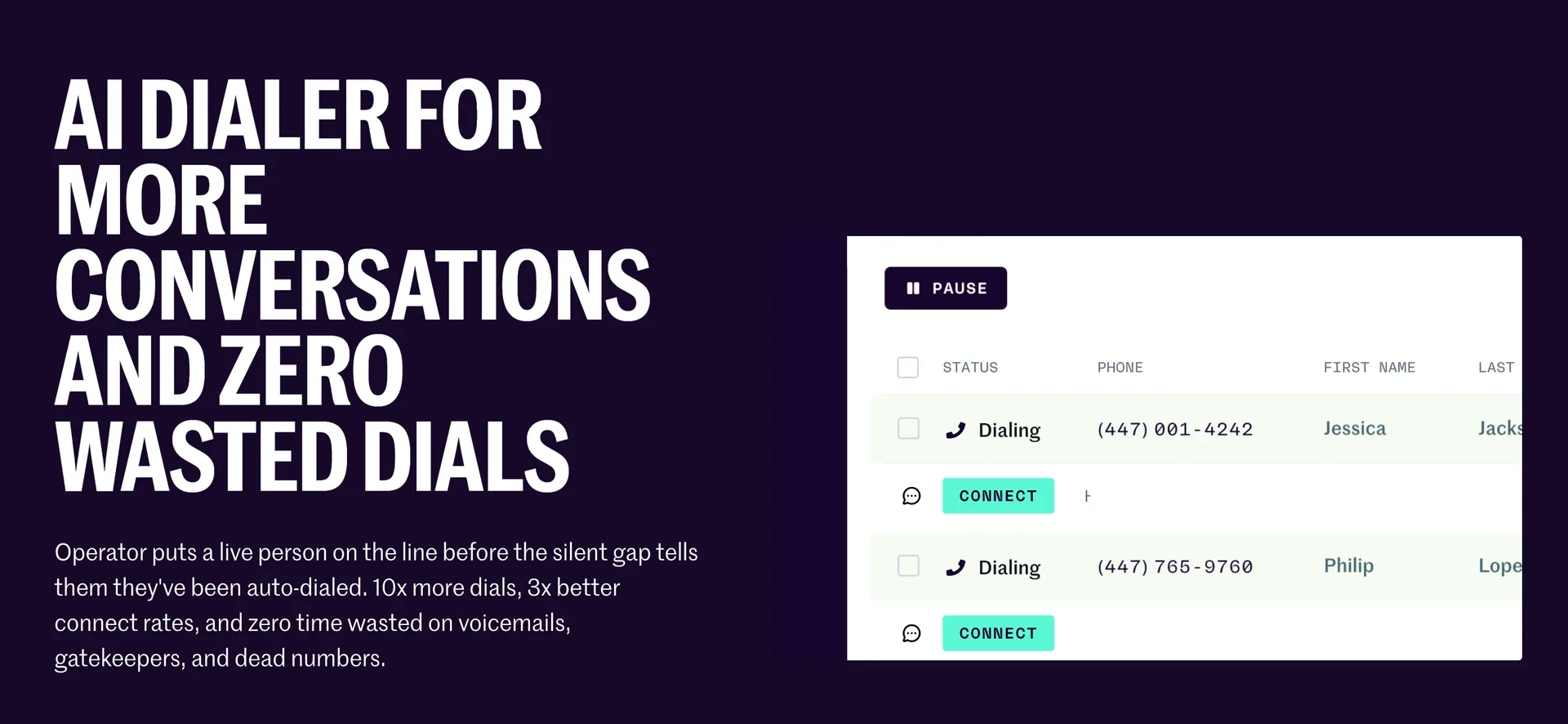
What works. The dialer goes up to 10 simultaneous lines, the highest throughput in this comparison. Voicemail detection and phone-tree navigation have been the core of the product for seven years, and it shows. An AI coaching suite, with call scoring and roleplay, was added in 2025.
What hurts. Two signals point the same way. First, the 9-seat minimum shown on the pricing page: below that, you do not get in. Second, average contract value, down from around $55k in 2022 to $30k according to Sacra, which attributes it to headcount cuts at enterprise customers. A per-seat model that is very exposed, in other words. And pricing is no longer public.
Who it is for. US teams of at least 9 seats, very high call volume, and a need for maximum lines.
3. ConnectAndSell, the hybrid model
ConnectAndSell is the elder of the market. The company has been selling conversations for more than a decade, and its approach remains the most unusual in this comparison, because it does not rely on software alone.

What works. The offer comes in two halves. Express Connect is the classic automatic mode: the system dials, filters out voicemails and switchboards, and hands you the first human voice. Precision Connect adds human agents who negotiate with executive assistants and front desks to reach one specifically named person. No software alone can do that. The in-house AI agent, CASSi, adds better number discovery, transcription and scoring.
What hurts. The hybrid model costs what it is worth, and nothing is public. The headline claims, eight times more pipeline and ten times more conversations, are marketing statements with no published methodology. The approach targets US enterprise accounts and assumes long cycles on named targets.
Who it is for. US enterprise sales, named targets that are hard to reach, substantial budget.
4. Koncert, obsessed with compliance
Koncert attacks the market from an angle the others treat as secondary: the health of your calling numbers and compliance with US telephone regulation.
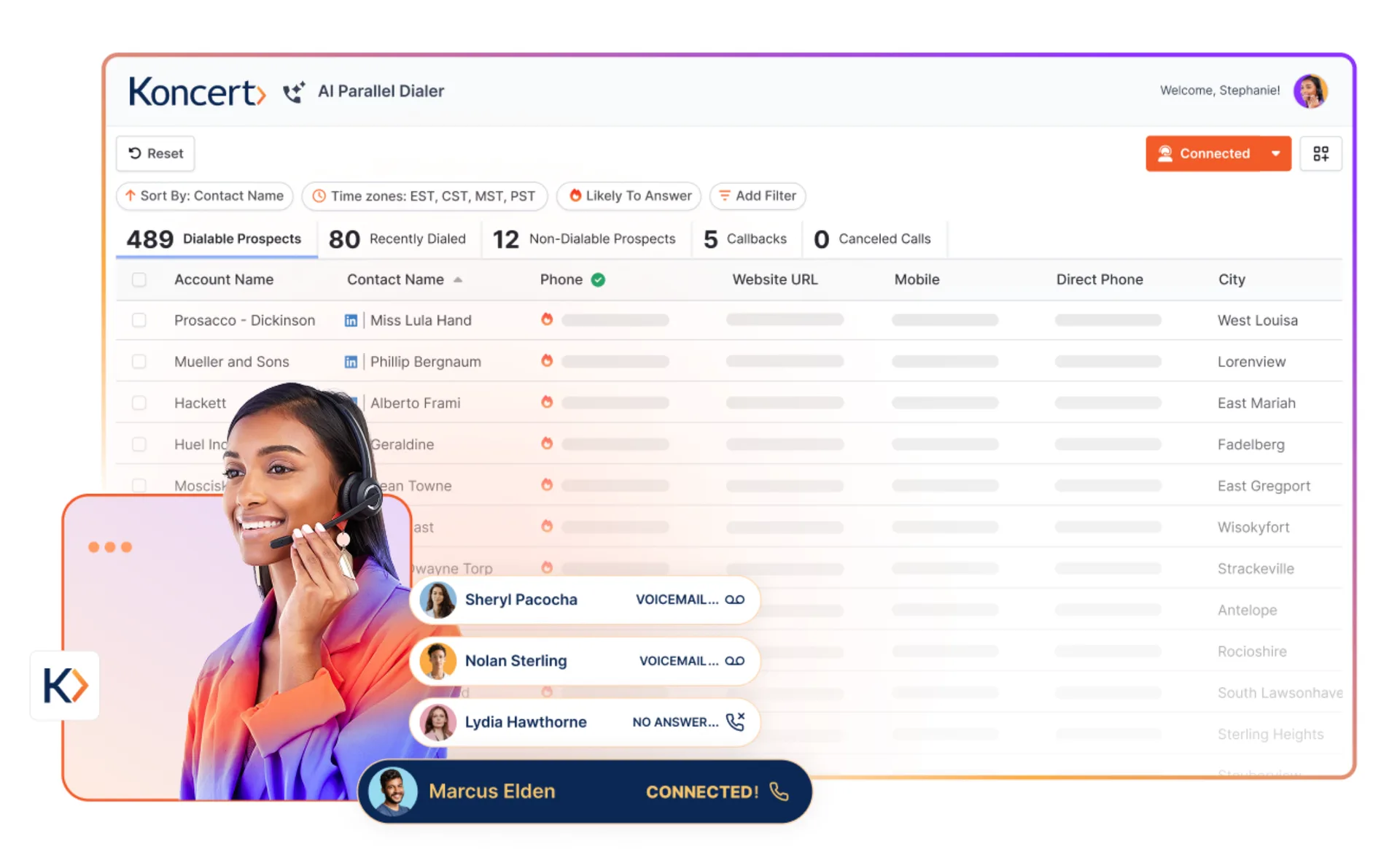
What works. Four dialers in the catalog, including a parallel one at 4 or 5 lines depending on the tier. Above all, the vendor holds a SOC 2 Type II certification and actively manages Caller ID health: it monitors spam flagging on your numbers and rotates them. This matters, because a flagged number kills your pickup rate far faster than a bad script. Koncert also sells its own telephony, Koncert Phone, which saves you the second contract.
What hurts. No public pricing, and no line count shown on the vendor's own site. The catalog is very crowded, between cadence, AI voice agent, data enrichment and a pitch lab, which blurs the picture. And the compliance grid is American: the TCPA says nothing about your European obligations.
Who it is for. High-volume US teams whose numbers keep getting flagged as spam.
5. Skipcall, our favorite
Skipcall was born in France, and the vendor did not stay on its home market: numbers included in 14 countries, more than 160 available on request, interface in French and English, website in seven languages. And it entered the category on price, with a product scope far wider than a dialer.
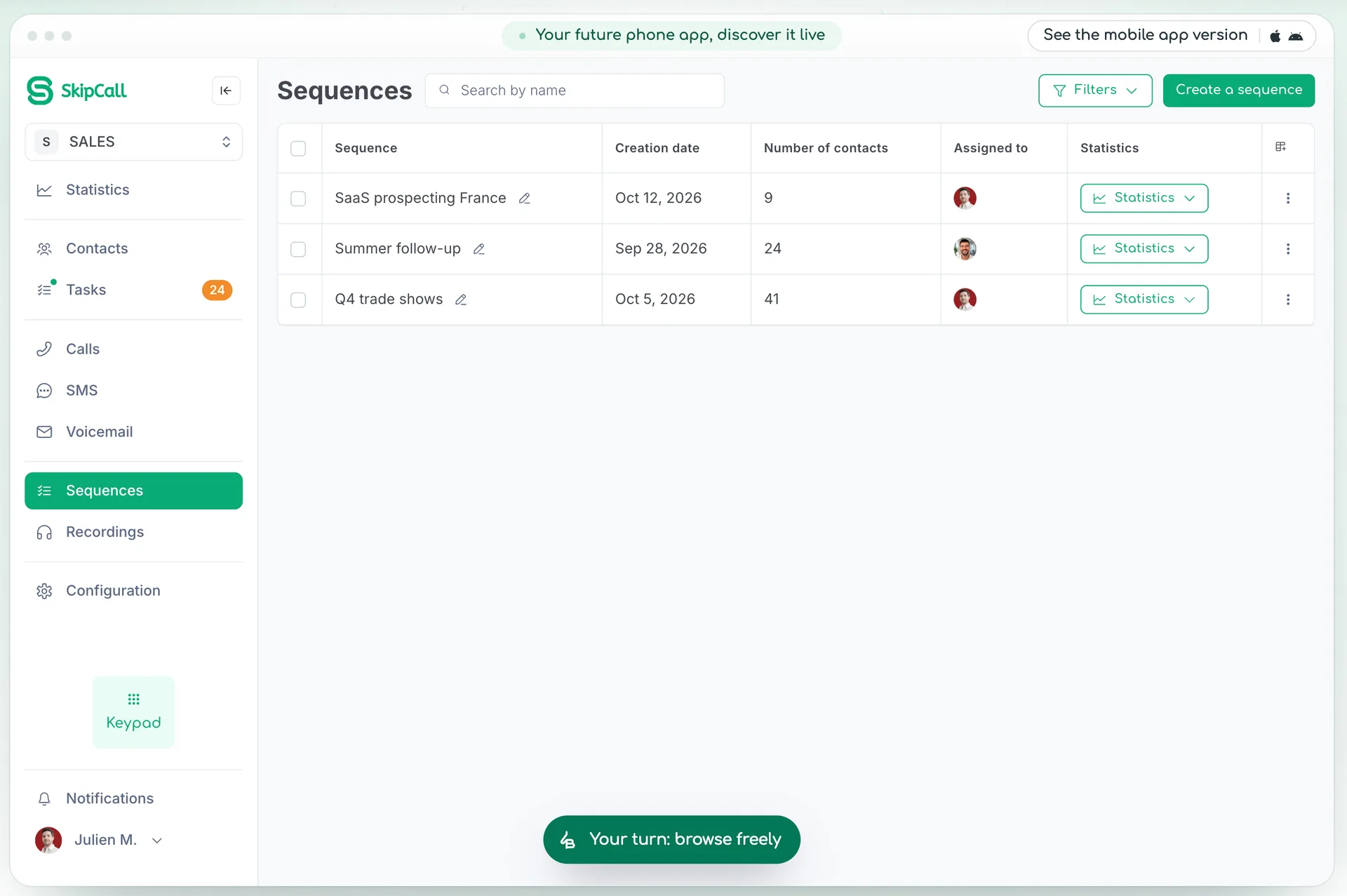
What really sets it apart
One contract instead of two. US parallel dialers sell software, not telephony. So you have to subscribe separately to a VoIP provider, and manage two subscriptions, two support desks, two invoices. Skipcall sells the telephony itself. The dialer, the numbers, the SMS and the billing are in the same product.
The price is public, and it is aggressive. €75 per user per month, €60 on annual billing, parallel dialer included. It is the only one of the five to display a full pricing grid, with no quote and no seat minimum. Orum, for its part, requires at least 9 seats before it will even discuss pricing.
A different plan per person. Inside the same organization, your rep can be on Starter with the parallel dialer while your project manager stays at €22 on the plain VoIP plan. Same interface, same invoice. None of the other four offers this, and for good reason: you have to sell the telephony to be able to do it.
International coverage. Numbers are included in 14 countries, including the United States, Canada, the United Kingdom, Germany and Switzerland, and more than 160 are available on request.
A scope wider than a dialer. Where the others sell a dialer, Skipcall sells the rep's entire phone setup. Here is everything in the product.
Area | What Skipcall does |
|---|---|
Telephony | Fixed and mobile VoIP numbers, inbound and outbound calls, SMS, numbers included in 14 countries and more than 160 on request |
Dialing | Parallel dialer with 4 lines, power dialer, AI voicemail detection, call sequences, automatic follow-ups by SMS or prerecorded voicemail |
Call analysis | Recording, transcription, AI summary, configurable recording notice |
Data and CRM | Pre-CRM contact base, CSV import, number enrichment, two-way sync with HubSpot, Salesforce, Pipedrive and Attio, open REST API and webhooks |
Operations | Tasks and reminders, dashboard, multi-team workspaces, per-user restrictions, a different plan per user |
Access | Web app, iOS and Android apps, SSO authentication |
Compliance | Hosting in the European Union, public DPA, list of subprocessors, configurable retention and deletion |
Coming soon | Click-to-call browser extension, MCP connector for AI assistants, virtual salesfloor with live coaching |
What to know before you sign
4 lines, not 10. Skipcall dials 4 numbers at once. That is the lowest figure in this comparison, tied with Koncert, and two and a half times less than Orum. On very cold lists, that ceiling shows. In exchange, a low ratio mechanically limits abandoned calls, which is precisely what European regulators watch.
No free trial. You create your account, you go through onboarding, you pay by card, and you are in. The subscription is monthly and cancellable at any time, so the risk is limited, but you have to pull out the card to see the product.
How to choose your parallel dialer in two questions
Only one vendor shows its price without a quote. Two questions are enough to pick the right parallel dialer.
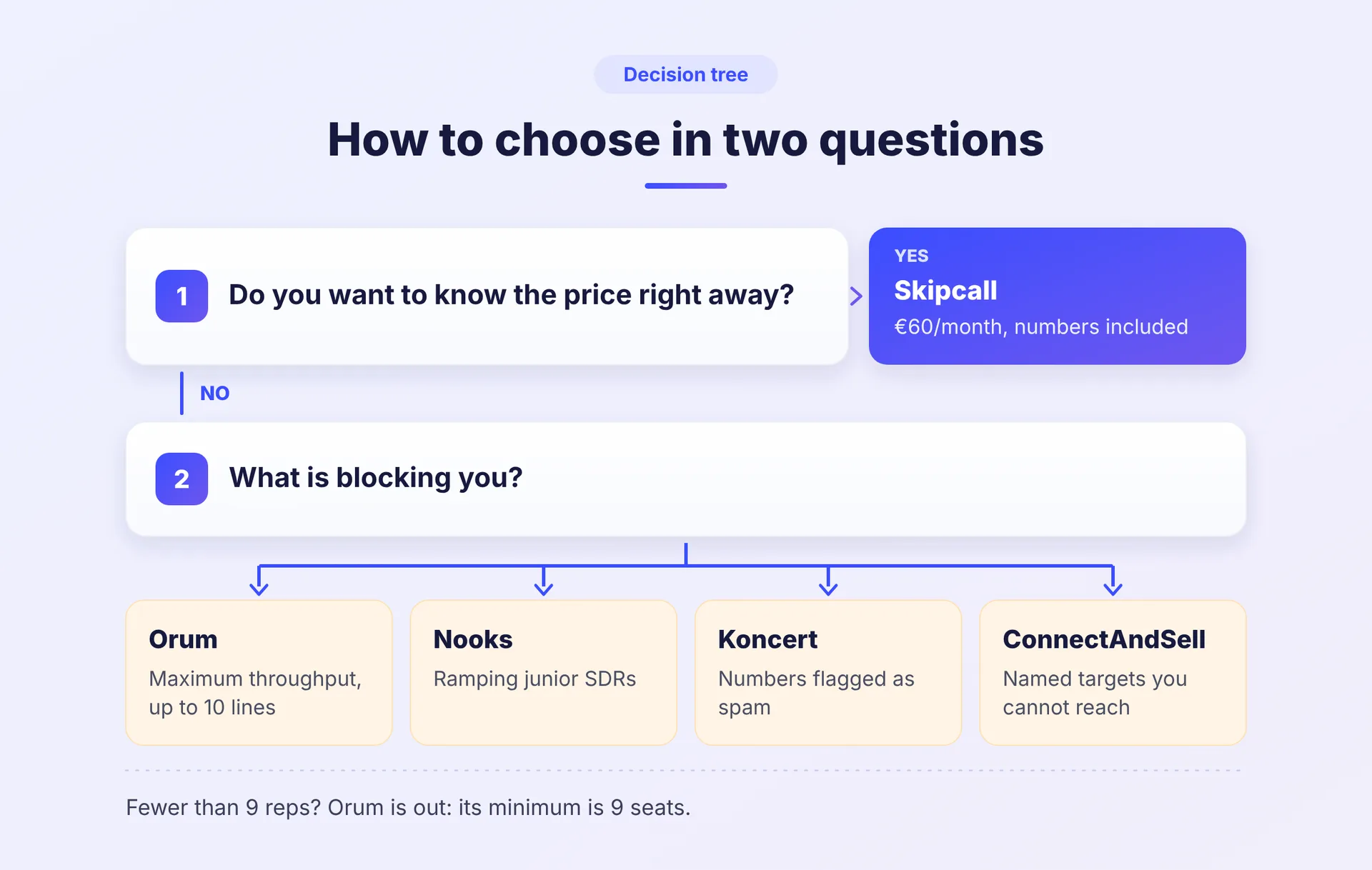
A third constraint can settle it before the other two: if there are fewer than nine of you calling, Orum rules itself out, its minimum is 9 seats. And if you want to know the price before talking to a rep, only one of the five vendors answers that question.
The tools that offer a parallel dialer as an add-on
A second family of tools offers the parallel dialer as a module of a wider platform. It is not their product, it is a line in their pricing grid, and it shows in use.
Tool | Simultaneous lines | Entry price | Cost of the parallel dialer |
|---|---|---|---|
Apollo | 5 | Free plan, then $49 per user per month | $119 per team per month as an add-on |
CloudTalk | 10 | $25 per user per month | $39 per user per month as an add-on |
Klenty | 2 to 10 | $70 per user per month | $45 per user per month as an add-on |
JustCall | Not specified | $29 per user per month | Included depending on plan |
Ringover | 2 | $15 per user per month | On quote |
ZoomInfo | Not specified | On quote | Included in Copilot Dialer |
Prices taken from the ZoomInfo market comparison, in dollars.
The math looks unbeatable, and sometimes it is. But add it up: at CloudTalk, $25 plus $39 makes $64 per user per month for a 10-line dialer. At Klenty, $70 plus $45 makes $115. The add-on often ends up more expensive than the base, and the dialer stays a secondary brick on the vendor's roadmap.
This family is the real threat to the category: with parallel dialing bolted on as an option everywhere, the pure-play market gets eaten from below.
What the parallel dialer market dynamics say
Three movements run through the category in 2026.
Prices are falling from below. Orum's average contract value reportedly went from around $55k in 2022 to $30k. Players under $100 per month have appeared, and generalist platforms add parallel dialing as a $40 option. Holding $250 per seat is getting hard without a very visible gap in value.
The market is still very American. Four of the five solutions in this comparison are US-based, calibrated on the TCPA and on established sales teams. In Europe, parallel dialing is most often offered by generalist telephony players, as an option and with two lines. The space there is wide open.
The per-seat model is fragile. Billing per rep means indexing your revenue on your customers' sales headcount. When they cut, revenue follows, even if the product is good. Vendors that also sell telephony, and therefore usage, absorb that cycle better.
Key takeaways on parallel dialers
For you, buying today, the conclusion fits in one line: the question is no longer whether parallel dialing works, but how many lines you actually need to pay for.
A parallel dialer works best on prospects who are already warm. Pair it with LinkedIn prospecting to make the first contact, find your prospects' phone numbers on LinkedIn, then call them right away: that is the whole point of effective multichannel prospecting.
FAQ: parallel dialer
A parallel dialer is calling software that dials several numbers at the same time and only connects you to the first person who picks up. Voicemails, switchboards and dead lines are filtered out automatically. It is mainly used for B2B sales prospecting over the phone, where most calls never connect.
A power dialer goes through numbers one by one, automatically. A parallel dialer calls several at once and only hands you the first person who answers. A predictive dialer dials more numbers than you have reps available, which produces abandoned calls, exactly what regulators watch.
Most vendors do not publish their prices and go through a quote, often with a seat minimum: 9 at Orum. Skipcall is the only one of the five with public pricing, €75 per user per month, or €60 on annual billing, telephony included. With generalist platforms and other sales tools, the parallel dialer is sold as an add-on.
Solutions on the market range from 4 to 10 lines. More lines mean more conversations, but also more abandoned calls and a higher risk of getting your numbers flagged as spam. For a team of four to fifteen reps, 4 lines strike a good balance. What matters is the number of real conversations that feed your sales pipeline.
It is not mandatory, but it is strongly recommended. Without a sync with your CRM, every call has to be logged by hand, and the time you save on the phone is lost on data entry. Check that the integration is two-way with HubSpot, Salesforce or Pipedrive.
The most effective approach is to call prospects who are already warm. Start with a LinkedIn campaign to make contact, collect the numbers of the people who accepted or replied, then call them with your parallel dialer. This multichannel approach fits into a broader B2B lead generation strategy and a clear sales plan.