
Podawaa or Waalaxy, the question comes up often, and it is badly framed. These two tools are not competing for the same job: one manufactures visibility, the other manufactures conversations.
Here is what each does, when one is enough, and why many end up using them at two different moments of the same movement.
Two problems, not one
The starting point. When a LinkedIn post gets thirty views, the problem is distribution. When you have a thousand views but nothing in the calendar, the problem is moving to a conversation. Two separate breakdowns. The plans and features in detail sit on Podawaa's official site.
Podawaa | Waalaxy | |
|---|---|---|
The problem it handles | Your post is not seen | You do not know who to talk to or who to follow up |
The movement | Attract, by amplifying content | Go and get them, profile by profile |
What comes out | Views, reactions, comments | Replies in your inbox |
The measure | Reach, impressions, profile visits | Acceptance rate, reply rate, meetings |
Confusing the two wastes time both ways: amplifying posts when you need meetings, or launching sequences when nobody knows who you are.
What Podawaa does
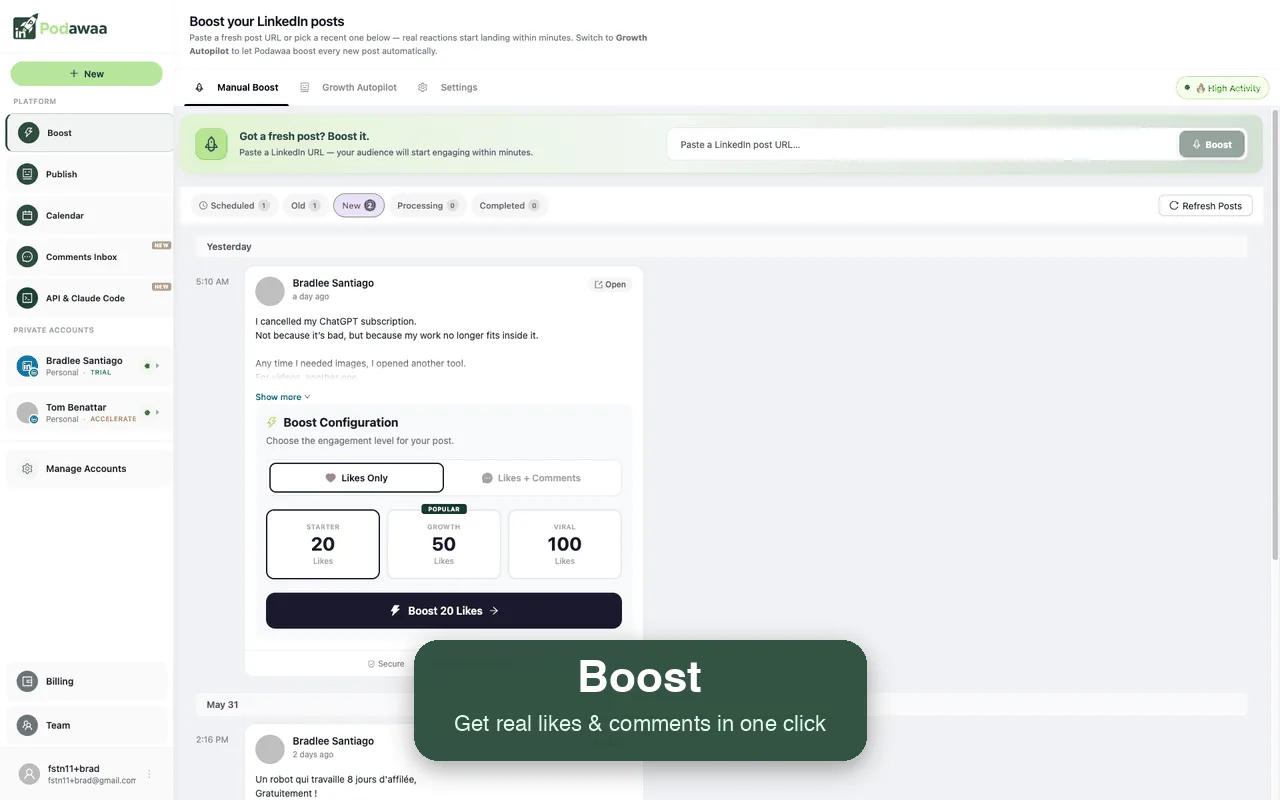
You paste a post URL, you pick a reaction volume, and real profiles react within minutes. The point is not the counter, it is the signal sent to the algorithm at the moment it decides whether to widen distribution.
Two modes coexist. On Community, your account reacts back on other members' posts, and that cannot be switched off. On Private, your account is never used, the engine runs in the cloud. The rest sits in our Podawaa FAQ.
What Waalaxy does
If you only know the tool by name, here is the principle. Waalaxy is a B2B LinkedIn outreach automation tool, built by the team behind this blog. It sits between a profile search and your calendar: you hand it a list, it handles the rest.
In practice it runs multi-channel sequences: a LinkedIn invitation, then messages, then a follow up email for whoever did not accept or did not reply. All in a single queue, with replies brought back to one place. Chrome extension and web app, with campaigns running from the Cloud even with your computer off.
The promise is not more prospects. It is no longer keeping by hand the table of who accepted what, and who has been waiting six days for a follow up. It sells against a time problem, not a volume problem.
The tool claims 200 000+ users and 4.8/5 across 5 000+ reviews, with a free 14 day trial and no card. And 75 % of customers had never automated outreach before, so the entry level is not an obstacle. The starting point is still defining your LinkedIn audience.
When one of the two is enough
There are clear cases, worth naming.
You already publish and nobody reads you. Your content holds up but it plateaus at your first circle. The subject is distribution, not outreach.
You know exactly who you want to reach. A list of a hundred CFOs in your region does not need to be won over by a post, it needs to be contacted.
You do not publish. Amplifying content that does not exist makes no sense. The subject is elsewhere.
You are drowning in replies. The problem is handling, not generating.
Why the two together work well
The real value shows when both run in parallel, because they feed each other.
An amplified post reaches people you would never have identified, and some of them look at your profile. An outreach sequence then lands with someone who has already crossed your name, which completely changes how the invitation is received.
The other way round, the people you contact will look at your feed before replying. A profile that publishes, and whose posts are alive, turns a stranger's invitation into a credible approach.
What remains is knowing which you lack first, the attention or the conversations.
What to know before choosing
Three practical points, often discovered too late.
The two tools are completely separate. Distinct accounts, distinct billing, no bridge between them.
Amplification has a hidden cost on the free version. On Community mode, your LinkedIn account engages on other members' posts, with no way to switch it off.
Amplification carries a reach risk. Badly dosed, it lowers your distribution instead of raising it. We break that down in our Podawaa review.
FAQ: Podawaa or Waalaxy
No. They are two completely separate tools, with distinct accounts and billing, and no integration between them. They do not handle the same problem either.
No, no bridge exists. They are used in parallel, at two different moments: visibility on one side, outreach on the other.
Whichever handles your current breakdown. If your posts are not seen, start with distribution. If you do not know who to write to or who to follow up, start with outreach.
No. An outreach sequence works with no posts at all. Publishing improves how the invitation is received, because the profile looks alive, but it is not a prerequisite.
The documented risk is not suspension but a drop in reach, when engagement forms too regular a pattern. Volume, spread over time and profile relevance are the three settings that count.