
Before giving a Podawaa review, one question has to be settled: does having strangers react to your posts damage your LinkedIn account, or not.
Here is what the tool does well, what it does less well, the real risk behind amplified engagement, and who it is honestly for.
What the tool does, in one minute
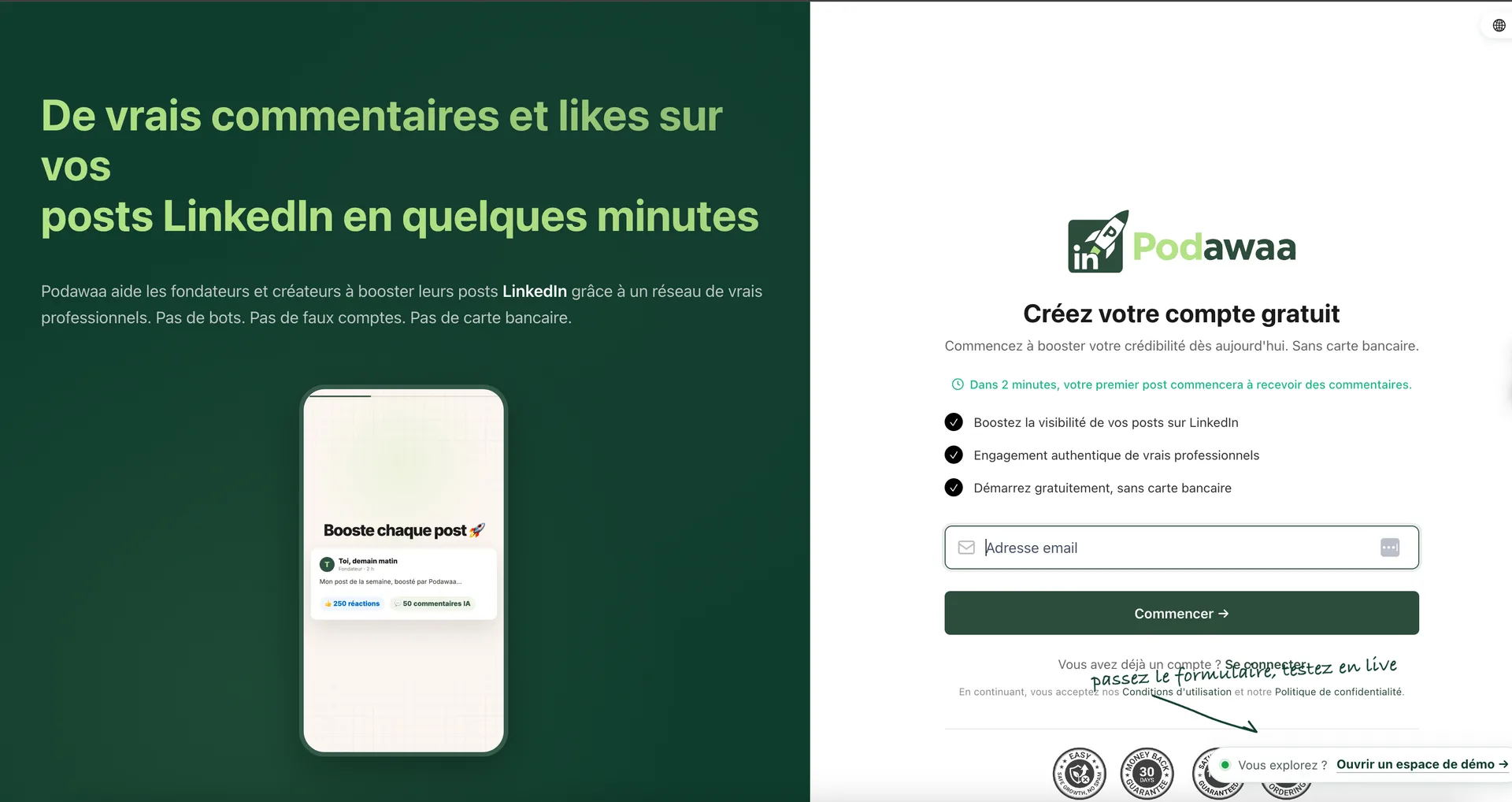
You paste the URL of a LinkedIn post, you pick a reaction volume, and real profiles like and comment within minutes. The goal is not the counter, it is the signal sent to the algorithm during the window when it decides whether to widen distribution. The plans and features in detail sit on Podawaa's official site.
The product also covers writing, scheduling and tracking comments. The full breakdown sits in our Podawaa FAQ.
The strong points
Three things set it clearly apart from classic engagement systems.
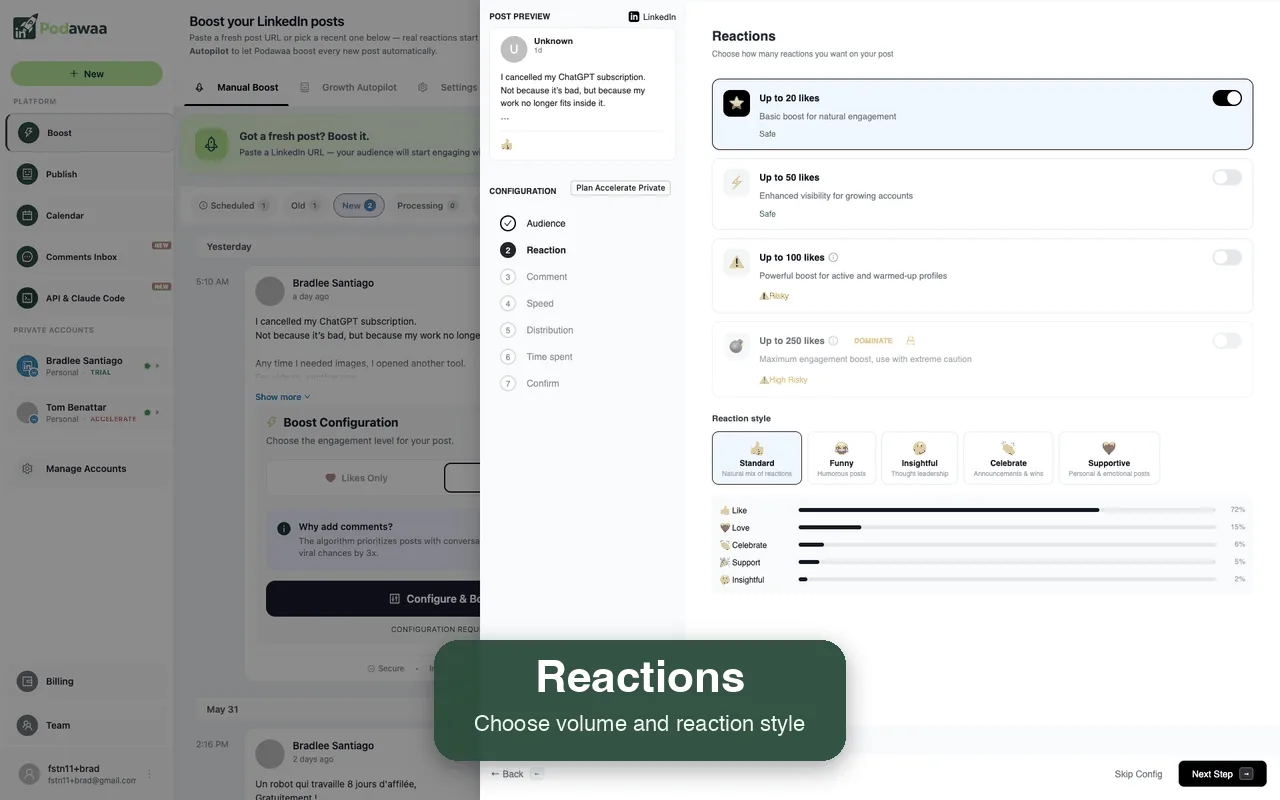
The risk is on screen. Every volume tier carries an explicit label, safe, risky or high risk. That is rare in this category, and it lets you decide knowing what you are doing.
The settings go deep. Delivery speed, distribution curve, reaction style, targeting by language and by industry. You can build engagement that looks like natural discovery rather than an artificial spike.
A mode without an extension exists. Private mode runs in the cloud, with no connection to your account and nothing to install. That is the point security teams care about most.
The limits, no dodging
A review without the reservations would be dishonest, and there are three.
The free mode has a hidden price. On Community, your LinkedIn account likes and comments back on other members' posts, and no setting stops it. It is written down, not hidden, but plenty of people find out afterwards.
The price doubles to avoid that. Private mode, the one where your account is never used, costs about twice as much at the same volume. We break the gap down in our piece on Podawaa pricing.
The tool solves one problem only. It manufactures visibility. It does not tell you who read, who is interested, or who to write to next.
The real risk: what LinkedIn reads
This is the question that should come before all others in a Podawaa review. No, LinkedIn does not detect a tool by name. What it reads are behavioural patterns, present whether you use a tool, a private group or nothing at all.
A recurrence of profiles: if the same people react to everything you publish, the algorithm infers the real size of your audience from that.
A timing that is too tight: when engagement lands inside a handful of minutes, the curve looks like no spontaneous reading.
A topic mismatch: comments that could sit under any post, written by profiles whose job has nothing to do with yours.
The outcome is not a ban, it is sneakier: your likes hold steady and your reach erodes, with no notification. LinkedIn learned your content only interests a small group. What the algorithm actually rewards is covered in our piece on LinkedIn reactions.
That is also what makes fine settings more than a gimmick: spreading over 24 to 48 hours and targeting by industry changes the nature of the signal. Our LinkedIn pod best practices cover the dosage.
Who it makes sense for
Profile | Verdict |
|---|---|
Creator who already publishes regularly | Makes sense. Amplification works on content that exists and holds up |
Founder building a personal brand | Makes sense on Private mode, to keep the account out of anything else |
Agency running client accounts | Makes sense, multi account is priced on the Private side only |
Someone publishing once a month | Barely relevant. The subscription pays off badly and the problem is elsewhere |
Someone looking for meetings | Off topic. Visibility is not a pipeline |
Our verdict in one sentence
It is a serious tool on ground that rarely is: it shows the risk instead of hiding it, it lets you set the delivery, and it offers a route where your account is never used. The rest depends entirely on how moderate you are with it.
The wrong way to use it exists and it is easy: open the taps wide, straight away, on every post. It produces likes and costs reach.
What an engagement tool will never do
An honest review says where it comes from. This blog is published by Waalaxy, which sells an outreach tool, not an engagement tool. The two do not compete, and that is exactly what makes the comparison useful.
Waalaxy serves something else: it is a B2B LinkedIn outreach automation tool. You start from a list of profiles, it runs invitations, messages, then follow up emails for whoever did not reply, and it hands the replies back in a single queue.
That is where any amplification tool stops. It works on content you already wrote, and it brings an audience whose names you do not know. An outreach tool starts from the opposite: you know exactly who you want to reach, and you measure replies, not impressions.
One point for beginners, and there are many: 75 % of Waalaxy customers had never automated outreach before. The free trial runs 14 days, no card, and starts with picking your LinkedIn audience.
Before choosing an amplification tool, check that your problem really is not being read.
FAQ: Podawaa review
The documented risk is not suspension but a drop in reach, when engagement forms a repetitive pattern. You control it through volume, spread over time and profile relevance. The tool does show a risk level on each tier.
Yes, from real LinkedIn profiles, picked from Smart Groups built from your account's interests. Targeting is set by language and by industry.
On Community mode yes, and it cannot be turned off. On Private mode never: no connection to your account, no password, nothing to install.
From 29 to 69 € a month on Community, from 59 to 159 € on Private, with a free entry point and a 7 day trial with no card. The detail is in our piece on Podawaa pricing.
No. Amplification works on the visibility of your posts. Finding the right people, contacting them and tracking replies is different work, which an outreach tool handles.