
A free LinkedIn pod exists, in several forms. None of them is truly without a trade, and it helps to know which one you are paying before committing.
Here is what a free LinkedIn pod covers, what it costs in time, in reputation or in reach, and the cases where it is plenty.
The three forms of free LinkedIn pod
The word covers very different realities, with very different trades. The plans and features in detail sit on Podawaa's official site.
Form | What you give in exchange |
|---|---|
Private mutual help group, on chat or in a closed group | Your time, every day, and your presence in a closed and regular circle |
Free mode of an engagement tool | Your account, which likes and comments on other members' posts |
Informal help between colleagues | Nothing, but the volume stays low and irregular |
None is really free. The first costs time, the second costs the use of your profile, the third costs nothing but does not produce much either.
The mutual help group and its hidden cost
It is the most widespread form and the riskiest, for a simple reason: it is always the same accounts, at roughly the same hour, on every one of your posts.
That is exactly the pattern the algorithm devalues. LinkedIn does not look for a tool by name, it reads behaviour. When the same twenty people react to everything you publish, it concludes your content interests twenty people, and stops testing it elsewhere.
The consequence is quiet: your likes hold steady and your reach drops, with no notification. We covered the signals that count in our piece on LinkedIn reactions.
The free mode of a tool: paid in kind
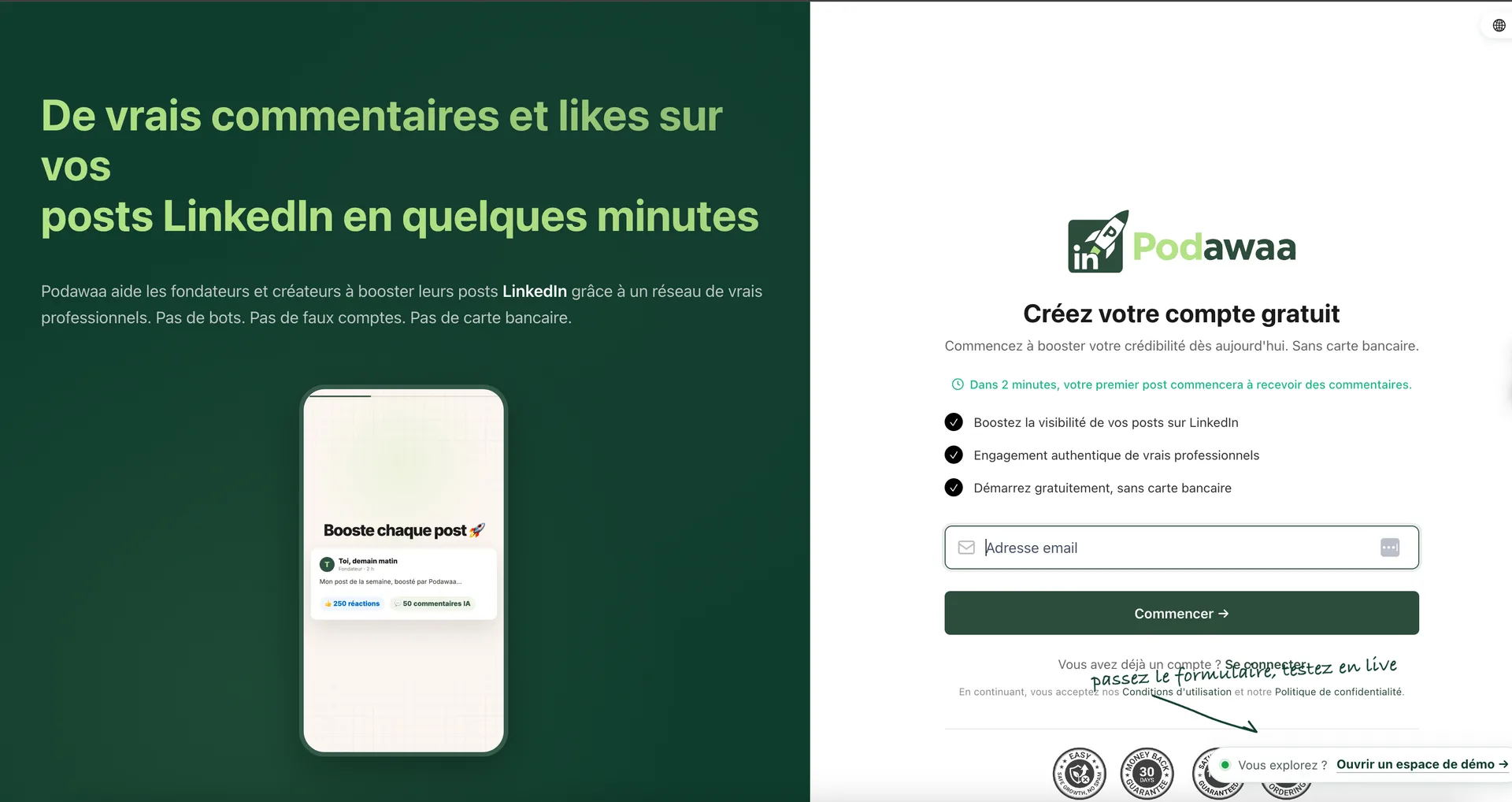
The second form is more comfortable, and its trade is explicit. At Podawaa for instance, the free entry runs on Community mode: your LinkedIn account likes and comments back on other members' posts, from the first exchange, and no setting stops it.
The advantage over a private group is real: the reacting profiles vary, targeting is set by language and by industry, and delivery can spread over 24 to 48 hours instead of landing in one block.
The downside fits in a sentence: your professional profile comments on posts you did not choose. To avoid it you have to move to the paid mode, about twice the price. The detail is in our piece on Podawaa pricing.
When free really is enough
There are genuine cases where looking further makes no sense.
You publish rarely. At one post a month a subscription does not pay off and informal help does the job.
You are testing the principle. Before paying, checking that amplification changes anything on your account is a healthy step.
Your audience is small. On an account with 500 connections, twenty extra reactions are enough to trigger a widening. No need for more.
In those three cases the real question is not the tool but the content. A weak hook amplified is still weak, just seen by more people.
What matters more than being free
Whatever the formula, three settings weigh more than the price on the final result.
Volume, which has to stay plausible against what your posts do naturally.
Spread over time, because fifty reactions over two days look nothing like a hundred in ten minutes.
Profile relevance, since off topic reactions teach the algorithm the wrong audience.
Our LinkedIn pod best practices cover the dosage of those three settings.
Where free stops working entirely
You have seen that free amplification is paid in time or in the use of your account. There is one place where it is not paid at all, because it does not exist: follow up work.
Contacting fifty people, noting who accepted, following up at the right moment, starting again next week: done by hand that is two hours a day. That is what Waalaxy handles, the LinkedIn outreach tool built by the team behind this blog. A list of profiles goes in, invitations, messages and follow up emails come out, and the replies land in one place.
Looking for free on amplification makes sense: the content is already written, it just needs a push. Looking for it on outreach means doing yourself, every day, repetitive work you give up on after three weeks.
Free always costs something. What remains is choosing the currency: your time, your account, or money. And in every case it starts with defining your LinkedIn audience.
If you spend more time organising like swaps than talking to customers, the maths is already done.
FAQ: free LinkedIn pod
No. Either you pay in time, returning engagement daily in a group, or you pay in use of your account, which automatically reacts to other members' posts.
They are the most exposed, because it is always the same accounts reacting. That is precisely the pattern that makes reach drop over time, with no warning at all.
A volume that is plausible for your audience. If your best organic post does 40 reactions, getting 250 creates a visible gap. Better to move up in steps over several weeks.
You need a paid formula where the account is never used. At Podawaa that is Private mode, with no extension and no connection to the account, billed at about twice the community formula.
The two modes, the settings and the pricing are laid out in our Podawaa FAQ.