
Are you looking to refine your sales strategy and better meet your customers' needs? Consultative selling is probably the solution for you. In this article, I'll explain this method in detail and show you how to use it effectively to transform your sales.
⭐️ Before we get started, let's define consultative selling:
How do you prepare for a consultative sales meeting? Our 8 tips!
1. Research and analyze your prospects before the meeting
Before the consultative selling meeting, you need to gather as much information as possible about your prospect. This preparation phase will enable you to better understand their needs and challenges. 👀
Define your persona :
This is the essential step! Defining your " is like drawing a sketch of your ideal customer. Knowing their characteristics allows you to better target your actions and personalize your approach. Don't miss out! 😉
Find prospects :
Now you know who your product is for. Now it's time to find your prospects! It may seem a complicated task, but with Waalaxy you can find your future customers in just a few clicks. You can identify prospects directly on LinkedIn. Thanks to the filters, you'll find profiles that match your target. 🎯
Customer analysis :
➡️ If it's a company, study the company's website, press releases, annual reports, decision-makers and any other publicly available information that may help you.
➡️ If it's an individual, pay attention to their buying habits: do they correspond to your buyer persona?
➡️ If you already have a relationship with this customer, examine previous interactions and proposed solutions.
🧰 Tools and techniques :
CRM tools: Use tools like Waalaxy to gather and analyze customer data.
Google Alerts: Set up alerts to keep up to date with the latest news about your prospect and their business.
2. Contact your prospects efficiently
Once you've collected and analysed all the information you need, it's time to contact your prospects. The tool I recommend is Waalaxy. It's an excellent extension because it will allow you to contact prospects via LinkedIn or email in an automated way.
Contact via LinkedIn
LinkedIn is an excellent way to establish initial contact.
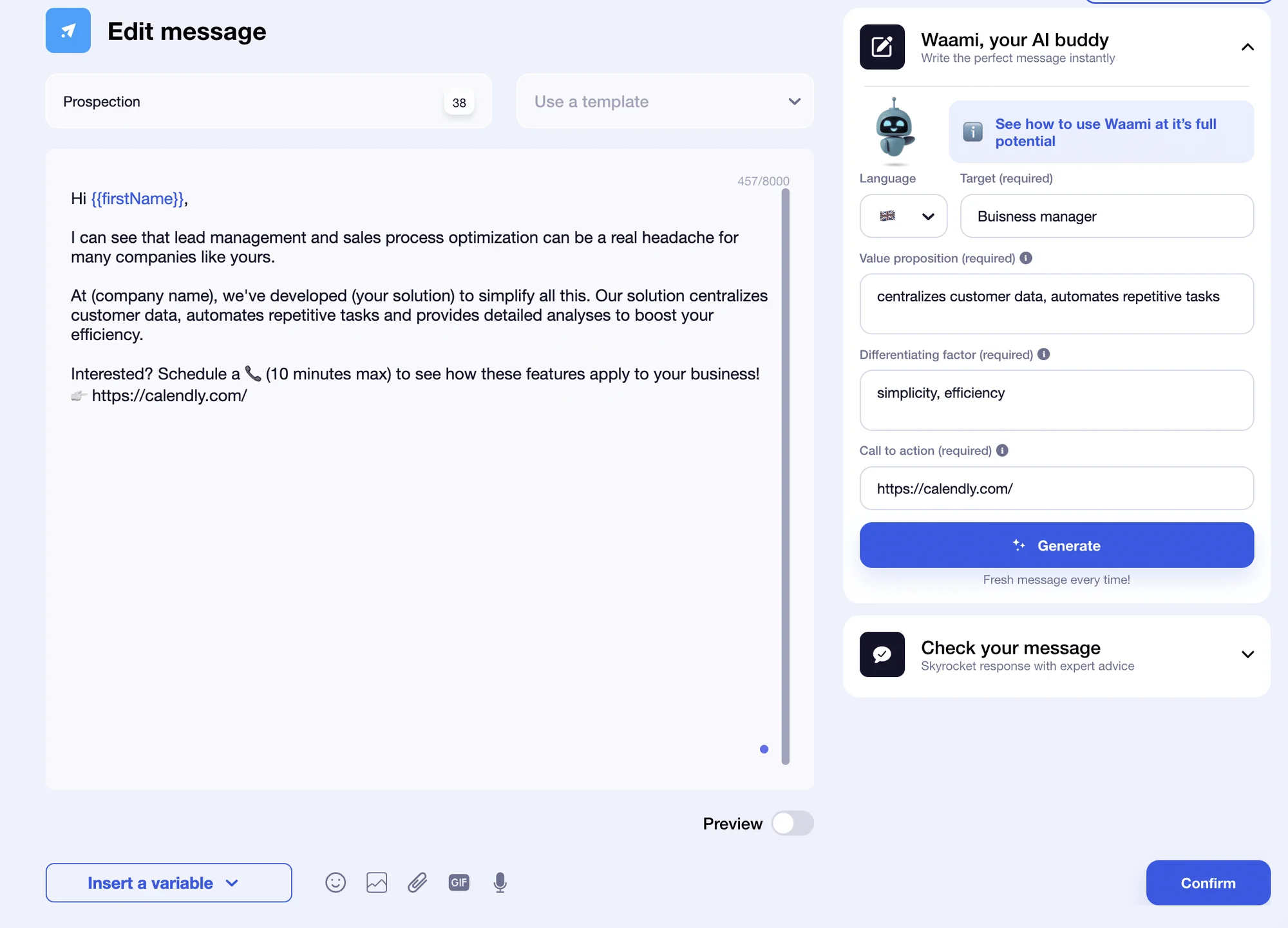
🖋️ Message writing: Once the connection has been accepted, send a LinkedIn message presenting your offer, highlighting the problem it addresses and the benefits for the prospect.
Sample of the prospecting message:
Contact by email
Email is a more formal but equally effective way of making initial contact.
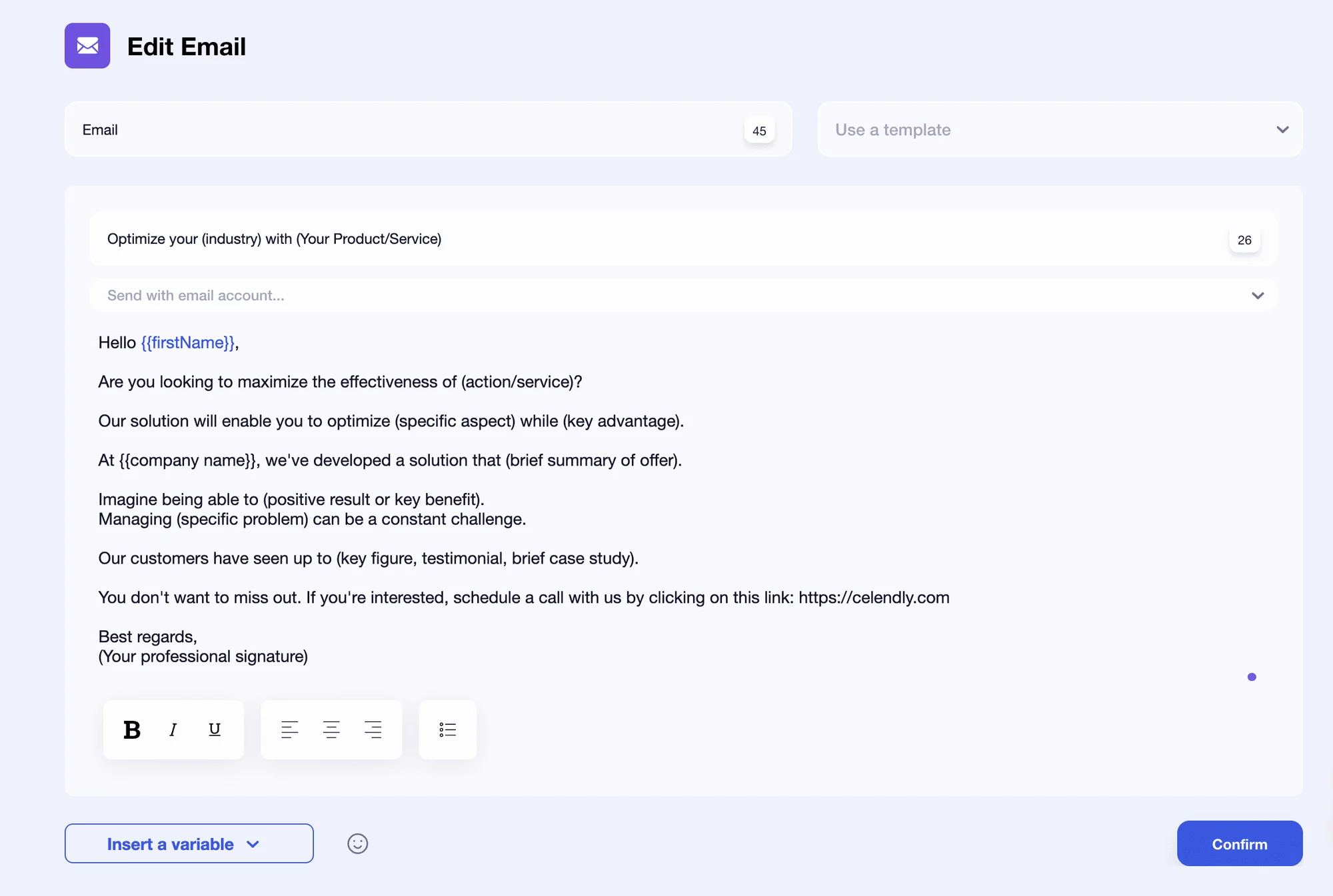
📨 The e-mail : Send a well-structured sales pitch, based on the information you've gathered. Mention the prospect's specific challenges and propose a suitable solution.
🚀 The follow-up : Don't forget to send a if you don't get a response after a few days, rephrasing your proposal concisely and adding new elements of value.
Email example:
🧰 Tools and techniques :
Templates: Select sequences to save time while getting a personalized approach.
Tracking tools : use Waalaxy to track opens, clicks and responses to your emails and messages to better plan your follow-up actions.
3. Understand your future customers' needs
The key to consultative selling is understanding the customer's specific needs and challenges. We advise you to set up :
🤔 Open-ended questions: prepare open-ended questions that encourage the customer to talk about their problems, goals and needs. For example, "What are your main current challenges?" or "What are your long-term goals for this year?"
👂🏻 Active listening: Practice active listening by rephrasing important points, showing that you understand and take on board the customer's concerns. But how? We'll get to that a little later.
🖋️ Note-taking: Write down key points for future reference and to show that you value the information the customer provides.
🧰 Tools and techniques :
Survey tools: Use surveys or questionnaires to find out the prospect's qualifications and obtain basic information before the interview.
4. Develop relevant questions
Prepare a list of relevant questions linked to your research that will help you deepen the understanding of the customer's needs and guide the conversation towards your solution.
👀 Specific questions: ask questions related to the challenges identified. For example, "How are you currently managing this problem?" or "What tools are you using to achieve this goal?"
🔎 Exploratory questions: Using this type of question uncovers unexpressed needs or potential problems. For example, "Are there aspects of your current process that you'd like to improve but haven't yet addressed?"
⭐️ Follow-up questions: probe the customer's answers and obtain further details. For example, if his goal is to improve customer satisfaction, you might ask: "What customer satisfaction indicators do you currently use to measure this aspect?"
🧰 Tools and techniques :
Brainstorming: Use tools like Miro or MindMeister to research and structure your questions with the help of your colleagues.
Commercial techniques: Learn and use questioning techniques such as SPIN selling (Situation, Problem, Implication, Necessity).
5. Prepare discussion scenarios
Anticipate the different directions the conversation may take and prepare discussion scenarios to stay flexible and responsive.
🎯 Success scenarios: Prepare examples of similar customers who have benefited from your solutions and succeeded in achieving their objectives with them.
🛡️ Resistance scenarios: Anticipate possible objections and prepare responses to address them effectively.
🔄 Alternative scenarios: Always have a plan B in reserve to propose alternatives if the solution initially proposed doesn't suit the customer.
🧰 Tools and techniques :
The inbox: Analyze previous interactions with your prospects with LinkedIn Waalaxy messaging to identify common objections.
6. Apply the active listening technique
You've prepared all your appointments, you know your customer. The active listening method is one of the essential for establishing a relationship of trust with the customer and understanding his or her needs.
👂 Listen without interruption: Let the customer talk without interrupting. Show you're paying attention by nodding and using non-verbal cues.
🗣️ Reformulate: Repeat or rephrase what the customer has said to confirm your understanding and show that you are listening attentively as in inside sales strategy..
🎯 Personalize: Make your answers and questions resonate with the customer. They need to feel unique. This will be a guarantee of quality and trust for him.
🧰 Tools and techniques :
Training: Take training courses or online courses on communication and active listening.
Record yourself: If possible, record your interviews (with the customer🚨s consent) to analyze them and improve your listening technique.
7. Demonstrate the value of your offer
It's important to demonstrate how your solutions can directly meet customer needs and add value. To do this, don't hesitate to prepare support material to back up your arguments.
📊 Metrics and data: Use statistics and data to support your proposals. Waalaxy can help you gather and analyze relevant data on your prospects.
💸 Return on investment (ROI ): Explain how your solution can save money or increase customer revenue.
📚 Case studies: Show concrete examples of similar customers who have benefited from your solution.
🧰 Tools and Techniques :
ROI calculators : Use online tools to calculate return on investment.
Analytical dashboards: Use tools like Power BI to present data in a simple, understandable way.
8. Follow up after the interview
Proper follow-up after the interview is essential to maintain the customer's interest and strengthen the relationship.
📝 Meeting summary: Send a summary email with key points discussed and next steps.
📧 Reminder of commitments: Confirm the actions promised on both sides.
📞 Availability: Remain available to answer any additional questions the customer may have.
🧰 Tools and techniques :
Follow-up email: Keeping a link with a customer is essential after your appointment, so don't hesitate to send them a follow-up email a few days after your meeting with a satisfaction questionnaire, for example.
Waalaxy: Use Waalaxy to manage and track all your interactions with prospects, from initial contact to post-interview follow-up.
The benefits of consultative selling
Consultative selling is more than just a transaction. It has other benefits for both salespeople and customers.😉
For sellers:
🤝 Improved relationships: By positioning themselves as a trusted advisor, salespeople build strong, lasting relationships with customers.
📈 Increased conversion rates: By responding precisely to customers' needs, the conversion rate from prospects to customers increases significantly.
🔄 Long-term loyalty: Customers satisfied with customized solutions tend to remain loyal and recommend the salesperson to others.
For customers:
🛍️ Personalized buying experience: Customers benefit from an approach that takes their specific needs into account, offering a more successful buying experience.
🧠 Better understanding of their needs: Thanks to the salesperson's active listening, customers can better understand their own needs and the solutions available.
🌟 Tailored solutions: The solutions offered are perfectly adapted to customers' expectations and challenges, increasing their satisfaction.
The disadvantages of consultative selling
While consultative selling has many advantages, it also comes with challenges that can make the process more complex and demanding. 🙃
For salespeople
⏳ Longer sales process: Consultative selling requires more time to understand the customer's needs and develop appropriate solutions.
🎓 Need more skills: Salespeople must possess communication, active listening and problem-solving skills.
📚 Ongoing training: To remain effective, salespeople must regularly update their knowledge and skills.
For customers
🕒 Greater commitment: Customers also need to invest more time in discussing their needs and evaluating proposed solutions.
🤯 Possible over-information: Some customers may feel overwhelmed by the level of detail and information provided by the salesperson.
Conclusion: what is consultative selling?
In a nutshell, consultative selling is :
🤝 Building strong relationships: You become a trusted advisor to your customers.
📈 Increase sales: Your prospects turn into customers more easily.
🔄 Build long-term loyalty: Satisfied customers come back and recommend you.
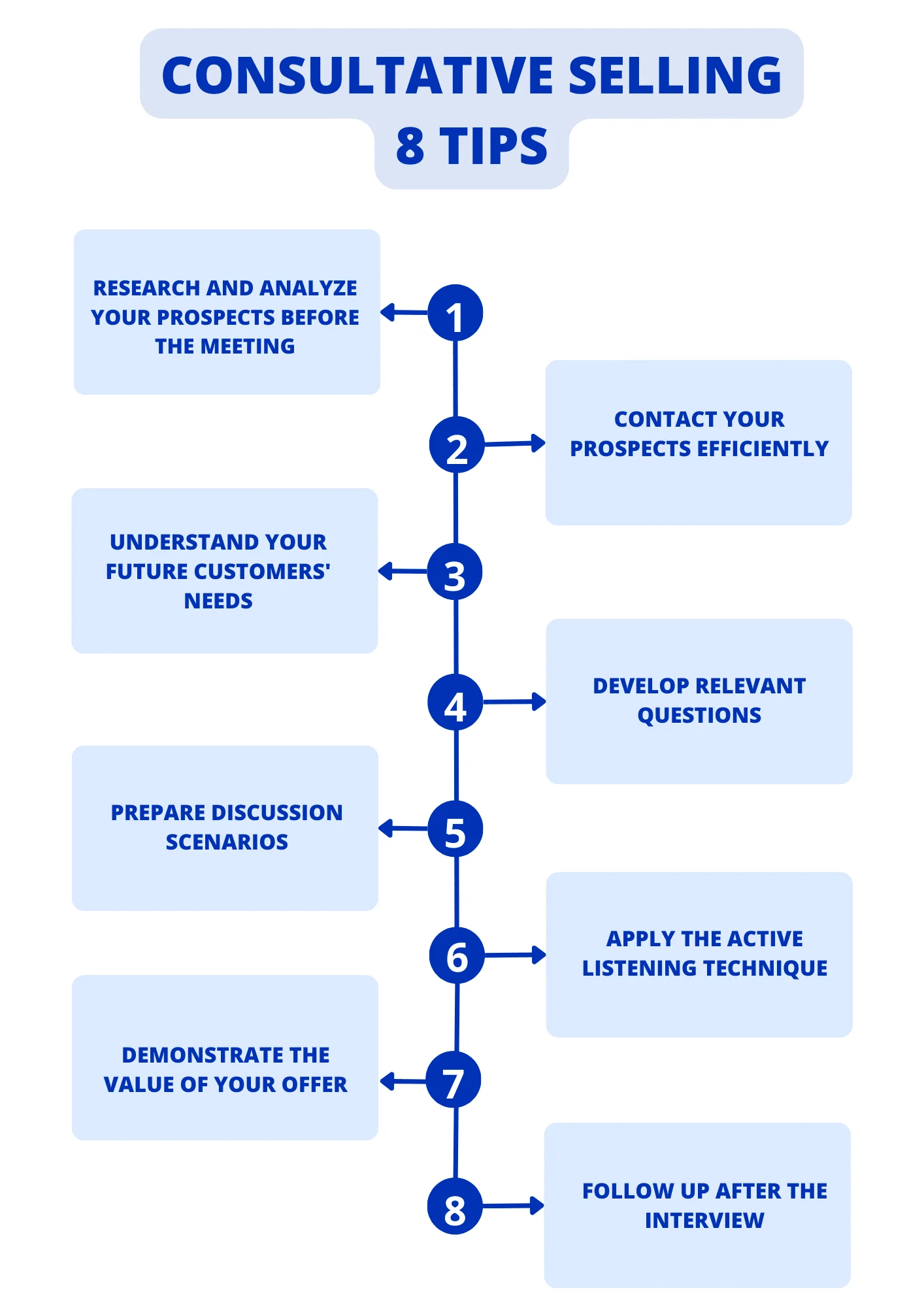
⭐️ With our 8 tips, you can succeed with this method:
Frequently asked questions
What is an example of consultative sales?
Here's an example of how to apply the consultative selling method I explained earlier. 👇🏻
What's the difference between traditional sales and consultative selling?
Criteria | Traditional sales | Consultative selling |
|---|---|---|
Main objective | To sell a product or service | Solve customer problems with customized solutions |
Approach | Transactional, product-centered | Customer-centric, advisory approach |
Customer relationship | Short-term, one-off transaction | Long-term, ongoing relationship |
Techniques used | Presentation of product features and benefits | Questioning, active listening, personalized advice |
Focus | Product features and pricing | Specific customer needs and challenges |
Sales process | Linear, scripted | Flexible, adapted to customer needs |
Salesperson's role | Sales representative | Advisor, consultant |
Results | Immediate sales, but no guarantee of customer loyalty | Loyalty, long-term customer satisfaction |
What are the different types of sales?
Each type of sale has its own tricks and techniques for attracting and convincing customers. Here's a quick overview of the different types of sales:
🏬 In-store sales: The classic method where customers come directly into a store to buy.
📞 Telephone sales: Here, it's all about phone calls, perfect for following up and converting prospects.
💻 Online sales: Everything via websites and e-commerce platforms. Shopping 2.0!
🔄 Subscription sales: Customers pay regularly to receive ongoing products or services.
🚪 Direct sales: Selling directly to consumers, often without intermediaries.
📦 Consignment selling: The retailer pays the supplier only after selling the products.
👩💼 Consultative selling: The salesperson acts as an advisor to help customers find the perfect solution.
🔀 Cross-selling: Offering complementary or additional products to customers.
⬆️ Upmarketing: Encouraging customers to opt for higher-end products or services.
So there you have it, a brief overview of the different types, it's up to you to define which one is best suited to your sales strategy.
Now you know all about consultative selling! 🚀